
Understanding Implied Probability in Sports Betting
 Available in US

Every betting odd tells a story about probability. When a bookmaker prices Manchester City at 1.50 to beat a relegation-threatened side, they are not picking that number arbitrarily – they are expressing a belief that City has roughly a 67% chance of winning. This translation from odds to probability is called implied probability, and understanding it is arguably the most important skill separating profitable bettors from the masses who perpetually lose money.
Implied probability strips away the confusion of different odds formats and reveals what the bookmaker truly believes about an event. It converts abstract numbers into tangible percentages that your brain can actually work with. Most people intuitively understand that something with a 70% chance is more likely to happen than something with a 30% chance. Far fewer can make the same intuitive judgment when comparing odds of 1.43 versus 3.33. Yet these numbers represent exactly the same probabilities.
The practical value extends beyond comprehension. We provide deep betting insights directly at MyBoxBet.com. Once you can calculate implied probability, you can compare your own assessment against the market’s view. If you believe an outcome has a 55% chance of occurring but the odds imply only 45%, you have potentially found a value bet. This comparison is the foundation of professional betting – not picking winners, but finding discrepancies between market prices and reality.
Table of Contents
Converting Odds to Probability
The conversion formulas differ slightly depending on which odds format you are working with, but all accomplish the same goal: translating a payout ratio into a percentage chance.
For decimal odds, the calculation could not be simpler. Divide 100 by the decimal odds to get the implied probability as a percentage. Odds of 2.00 imply a 50% chance (100 divided by 2). Odds of 4.00 imply a 25% chance (100 divided by 4). Odds of 1.25 imply an 80% chance (100 divided by 1.25). The formula works universally regardless of whether you are dealing with heavy favourites or extreme longshots.
This simplicity is precisely why decimal odds have become the international standard. A quick mental calculation tells you everything you need to know. When you see odds of 2.50, you immediately know the market gives this outcome a 40% chance. When you see 1.80, you know it is approximately 55.6%. After enough practice, these translations become second nature, and you begin thinking in probabilities rather than payout multiples.
For fractional odds, the formula requires one additional step. Add the numerator and denominator together, then divide the denominator by that sum. For odds of 3/1, you add 3 plus 1 to get 4, then divide 1 by 4 to get 0.25, or 25%. For odds of 1/4, you add 1 plus 4 to get 5, then divide 4 by 5 to get 0.80, or 80%. The denominator always represents your stake in fractional terms, so it makes sense that it forms the basis of probability calculation.
For American odds, the calculation differs based on whether the number is positive or negative. For positive odds like +200, divide 100 by the sum of the odds plus 100. So +200 gives you 100 divided by 300, which equals 33.3%. For negative odds like -150, take the absolute value (150), divide it by the sum of itself plus 100, giving 150 divided by 250, which equals 60%. The asymmetric nature of American odds makes these conversions less intuitive, which is one reason experienced bettors often prefer working in decimal format.
The Overround Problem
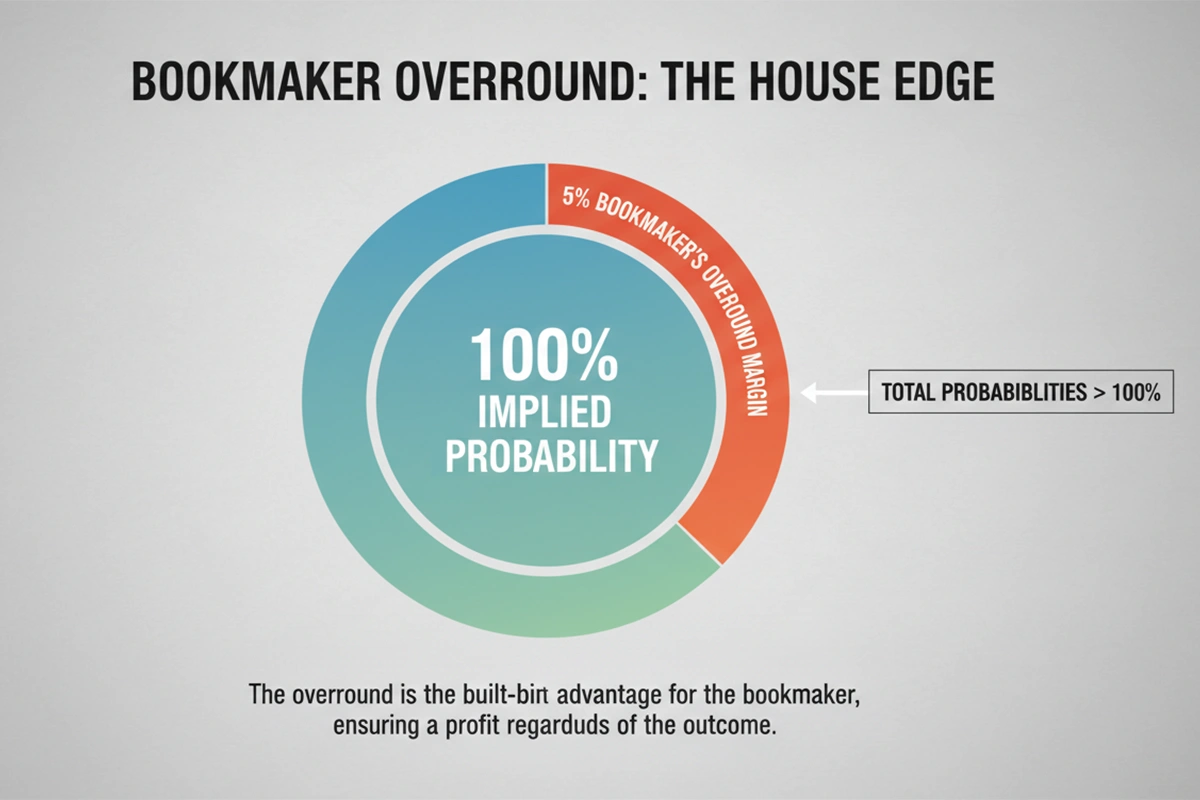
Here is where things get uncomfortable for casual bettors. If you convert all possible outcomes of an event to implied probabilities and add them together, the total will exceed 100%. In a theoretically fair coin toss, heads should be 50% and tails should be 50%, totalling exactly 100%. But in the real world of bookmaking, you will find heads priced at 1.91 (52.4% implied) and tails also at 1.91 (52.4% implied), totalling 104.8%.
That extra 4.8% is the bookmaker’s margin, also known as the overround, vig, or juice. Notice that probabilities total more than 100% due to bookmaker margins and vig. It represents the mathematical edge built into every market, ensuring the bookmaker profits regardless of the outcome. The higher the overround, the worse the odds for bettors. A market with 104% total implied probability is far more favourable than one with 110%. Sharp bettors obsessively seek out markets with low overround because it directly impacts their potential returns.
Understanding overround also reveals which bookmakers offer the most competitive prices. Some operators consistently run markets at 102-103% overround, while others push it to 108-110%. Over hundreds of bets, the difference is substantial. Betting at a high-margin bookmaker is essentially paying an unnecessary tax on every wager. The calculation is straightforward: add up the implied probabilities for all outcomes in a market, and the amount exceeding 100% is your disadvantage.
The overround also varies significantly between sports and markets. Premier League match results might carry a 3% margin while an obscure table tennis match might carry 8%. Bookmakers price familiar, high-volume markets more competitively because they have more data and face more competition. Exotic markets and minor leagues allow them to build in larger margins because fewer sharp bettors are paying attention.
Finding Value Through Probability Assessment
The entire concept of value betting rests on comparing implied probability to your own probability estimates. A bet has positive expected value when the true probability of winning exceeds the implied probability from the odds. Conversely, a bet has negative expected value when the implied probability exceeds the true probability – you are paying more than the outcome is worth.
Consider a simple example. A bookmaker offers odds of 2.50 on Team A winning, implying a 40% chance. Through your research and analysis, you determine that Team A actually has a 50% chance of winning. This discrepancy represents value. If you made this exact bet thousands of times, you would expect to profit because the odds are better than they should be relative to the true probability.
The expected value formula quantifies this edge: multiply your estimated probability by the potential profit, then subtract the probability of losing multiplied by your stake. Using the example above with a $100 bet at 2.50 odds (50% true win probability, 50% loss probability):
EV = (0.50 x $150) – (0.50 x $100) = $75 – $50 = $25
This positive expected value of $25 per $100 bet suggests a profitable opportunity. Over time, consistently finding bets with positive expected value is the only reliable path to profit. The challenge, of course, is accurately estimating the true probability – a task that requires deep knowledge, quality data, and honest self-assessment.
Negative expected value works identically in reverse. If the implied probability is 60% but your assessment suggests only a 50% chance, the bet destroys value no matter how confident you feel about the pick. Many recreational bettors fall into this trap, backing outcomes they like without considering whether the price is fair. They might win individual bets, but the mathematics guarantee long-term losses.
Practical Application of Probability Thinking
Shifting from outcome-based thinking to probability-based thinking fundamentally changes how you approach betting. Instead of asking “will this team win?” you ask “is this team more likely to win than the odds suggest?” These are entirely different questions with entirely different implications for your bankroll.
A team might be virtually certain to win yet still represent a bad bet if the odds are too short. Imagine a heavy favourite priced at 1.05, implying a 95.2% chance of winning. Even if you believe they have a 96% chance, the expected value is marginal at best. The tiny potential profit does not justify the risk, especially when a 4% chance of losing wipes out twenty winning bets. Conversely, a massive underdog at 15.00 (6.7% implied) might represent excellent value if your analysis suggests a 10% true probability – even though losing is the most likely outcome.
This probability-first approach also protects you from common cognitive biases. Recency bias makes people overweight recent results, but a team’s true quality does not change dramatically from week to week. Public sentiment often pushes odds on popular teams below fair value while creating opportunity on less glamorous opponents. By focusing on probability rather than predictions, you insulate yourself from emotional reasoning.
Developing probability estimation skills takes time and honest record-keeping. Track your bets alongside your pre-bet probability estimates. Over hundreds of wagers, you will discover whether your 60% confidence picks actually win close to 60% of the time. If your 60% picks win only 45% of the time, your estimates are systematically overconfident and need recalibration. If they win 70% of the time, you are underestimating yourself and should bet more aggressively when you identify value.
Why Most Bettors Fail to Use This Knowledge
Implied probability is not difficult to understand, yet the overwhelming majority of bettors never incorporate it into their decision-making. They select bets based on gut feeling, team loyalty, or the desire for excitement. They see odds of 3.00 and think “triple my money” rather than “33% chance of winning.” This fundamental framing error explains much of the industry’s profitability.
Bookmakers actively discourage probability thinking through their interface designs and marketing. Potential payouts are prominently displayed while implied probabilities are buried or absent entirely. Accumulator promotions emphasize the massive potential returns rather than the minuscule probability of winning. The entire customer experience is optimised to make you bet more frequently and less thoughtfully.
The psychological barrier is equally significant. Thinking in probabilities requires accepting uncertainty – acknowledging that even your best bets will lose a meaningful percentage of the time. Many people prefer the false comfort of picking winners, as if certainty were ever possible in sports. They would rather believe they found a sure thing than accept a 60% edge and the inherent variance that accompanies it.
Professional bettors have no such illusions. They understand that long-term profitability comes from accumulating small edges across many bets, not from being right on any individual wager. They view losses as the cost of doing business, expected and budgeted for in advance. This mindset only becomes possible when you truly internalise that betting is about probability, not prediction.
Building Your Probability Framework

Start by calculating implied probability for every bet you consider, even if only mentally. Make it a habit before placing any wager. What probability does this price imply? Do I believe the true probability is higher or lower? If lower, walk away. If higher, quantify the difference before determining stake size.
Develop sport-specific knowledge that allows you to make probability estimates grounded in data rather than intuition. Football expected goals models, basketball efficiency ratings, tennis surface adjustments – whatever metrics best predict outcomes in your chosen markets. Your estimates need not be perfectly accurate, but they need to be more accurate than the market’s to generate profit.
Compare your estimates against closing lines to measure your edge over time. Closing line value, the difference between your bet price and the final price before an event starts, is one of the best predictors of long-term success. If you consistently beat the closing line, your probability estimates are likely superior to the market’s. If you consistently take worse prices than the close, you are likely overestimating your edge.
Finally, embrace the variance inherent in probability-based betting. A bet with 60% true win probability will lose 40% of the time – that is not bad luck, it is mathematics. Losing streaks are inevitable and say nothing about the quality of your process. Only large sample sizes reveal whether your edge is real. Patience and discipline matter as much as analytical skill in transforming probability knowledge into profit.