
Trifecta Box Calculator How to Maximize Your Racing ROI
 Available in US
I still remember the first time I hit a trifecta. It was at Monmouth Park, a rainy Tuesday in September, and I had absolutely no idea what I was doing. I boxed six horses because I couldn’t make up my mind, spent $120 on a bet I didn’t understand, and somehow walked away with $1,847. Pure blind luck. If I knew then what I know now about trifecta mathematics, I probably could have hit that same payout for a quarter of the cost.
That’s the thing about trifectas that drives me crazy. Everyone knows they exist, everyone knows they can pay well, but almost nobody actually understands the mathematics behind them. Before placing complex bets, ensure you understand exacta box betting basics. They just throw horses into a box, pray to the racing gods, and wonder why their bankroll keeps shrinking despite hitting the occasional score.
Today, we’re going to fix that. Return to the homepage for more betting strategies. We’re diving deep into the actual numbers behind trifecta betting, and I’m going to show you exactly how to calculate costs, evaluate opportunities, and most importantly, structure your trifectas for maximum ROI instead of maximum hope.

Table of Contents
- The Complete Trifecta Cost Tables You’ll Actually Use
- Building Your Own Trifecta Calculator That Actually Works
- Wheel vs Box: The $50,000 Question
- Common Trifecta Mistakes That Destroy Bankrolls
- Advanced Trifecta Structures Nobody Teaches
- Track-Specific Trifecta Angles That Print Money
- The 10-Minute Morning Routine That Makes Profitable Trifectas
- The Trifecta Bankroll Formula Nobody Uses (But Should)
- Reading the Trifecta Tote Like a Professional
- The Psychology of Trifecta Success
- The International Trifecta Edge**
- Database Building for Serious Players
- The Trifecta Automation Revolution**
- Trifectas in Major Stakes Races**
- Claiming Race Trifecta Mastery**
- The Festival of Chaos Theory**
- When to NOT Bet Trifectas**
- Building Your Trifecta Business**
- The Future of Trifecta Betting**
- Your Trifecta Evolution Roadmap**
- Trifecta box profitability blueprint: costs, structures, and edge triggers
The Complete Trifecta Cost Tables You’ll Actually Use
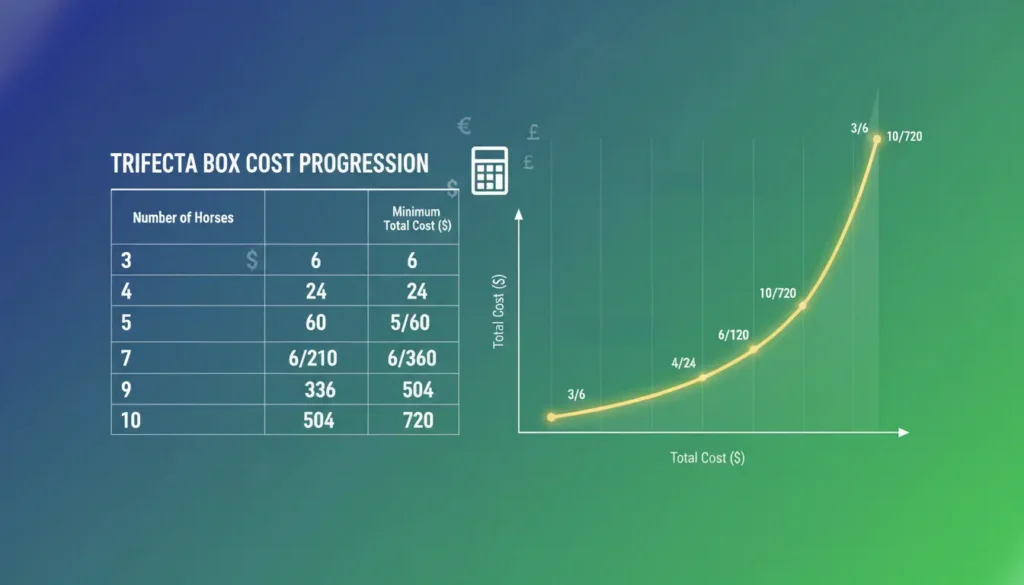
Let’s start with the brutal truth about trifecta box costs, because if you don’t understand this, everything else is meaningless. The formula is simple: n × (n-1) × (n-2) × base bet amount. But what that looks like in real dollars will make your head spin if you’re not prepared.
Here’s the comprehensive breakdown for $1 base bets:
- 3 horses: $6
- 4 horses: $24
- 5 horses: $60
- 6 horses: $120
- 7 horses: $210
- 8 horses: $336
- 9 horses: $504
- 10 horses: $720
Now look at that progression. From 3 to 4 horses, you quadruple your bet. From 5 to 10 horses, you’re multiplying by twelve. This exponential growth is why most trifecta boxers go broke, even when they hit regularly.
But here’s what the books don’t tell you: the cost table is just the beginning. The real calculation you need to master is cost per realistic combination. Not every combination in your box has an equal chance of hitting. If you’re boxing the 1-2 favorite with five longshots, the combinations where three longshots finish 1-2-3 are essentially worthless. You’re paying for them, but they’re not really live.
I developed what I call the “Realistic Combination Calculator” that changed my entire approach. Instead of looking at raw combinations, I assign probability weights:
High probability combinations (favorites with logical contenders): Weight of 1.0 Medium probability (one favorite with two prices): Weight of 0.5 Low probability (three longshots or illogical orders): Weight of 0.1
Using this framework, that 6-horse box for $120 might only have $45 worth of realistic combinations. Suddenly, the math looks very different. You’re not getting 120 combinations for $120; you’re getting maybe 45 viable ones, meaning you’re really paying almost $3 per realistic combination, not $1.
This is why blind boxing is death. You’re paying full price for combinations that have virtually no chance of occurring. It’s like buying insurance on a house in the desert against flood damage. Sure, theoretically it could happen, but you’re lighting money on fire.
Building Your Own Trifecta Calculator That Actually Works
Every trifecta calculator online does the same thing: multiplies horses by the formula and spits out a cost. Useless. What you need is a calculator that factors in the variables that actually matter for ROI. I’m going to show you how to build one that actually helps you make money.
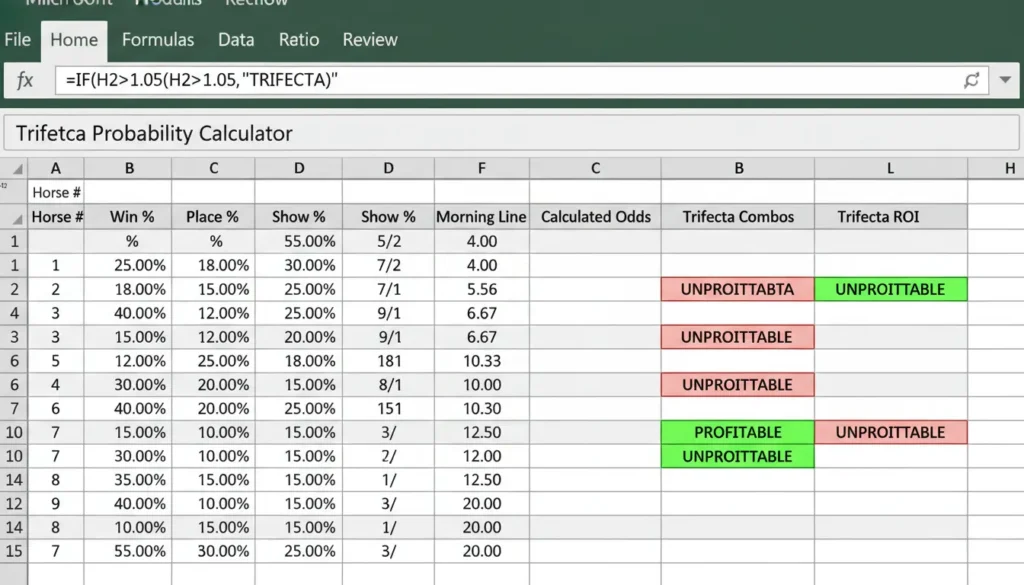
First, forget about fancy apps. Open a spreadsheet. Excel, Google Sheets, I don’t care. You need something you can customize and actually understand. Here’s the framework I’ve refined over fifteen years:
Start with five columns:
- Horse number
- Win probability (your assessment)
- Place probability
- Show probability
- Morning line odds
The magic happens when you add formulas. For each potential trifecta combination, multiply the individual probabilities. A 1-2-3 trifecta probability equals Horse 1 win probability × Horse 2 place probability × Horse 3 show probability. But here’s the crucial adjustment: you need to normalize these probabilities based on the horses not being able to finish in multiple positions.
The normalization formula is where people get lost, but it’s actually straightforward. If Horse 1 has a 30% win probability, Horse 2 has a 25% win probability, and Horse 3 has a 20% win probability, the chance of them finishing exactly 1-2-3 is NOT 0.30 × 0.25 × 0.20. You have to adjust for the fact that if Horse 1 wins, Horse 2 can’t win.
The adjusted formula becomes: 0.30 (Horse 1 wins) × (0.25/0.70) (Horse 2 places from remaining probability) × (0.20/0.45) (Horse 3 shows from remaining). That gives you about 4.8% instead of 1.5%. That’s more than triple the naive calculation, and it’s why most people dramatically underestimate their chances in trifectas.
But probability is only half the equation. You need expected value, and that requires payout projections. This is where my calculator gets interesting. I track historical payouts based on the favorite’s odds and the number of horses in the field. Over thousands of races, patterns emerge:
In an 8-horse field with a 3-5 favorite:
- Chalk trifecta (1-2-3 favorites): Median payout $28
- One bomber (favorite-favorite-longshot): Median payout $187
- Two bombers: Median payout $847
- Three prices: Median payout $4,500+
Input these historical medians into your calculator, and suddenly you can calculate expected value for every possible trifecta box before you bet it. When the expected value exceeds the cost by 20% or more, that’s a play. Anything less is a pass.
Wheel vs Box: The $50,000 Question
This is the debate that’s raged since trifectas were invented: is it better to wheel or box? The answer, like everything in gambling, is it depends. But I can tell you exactly what it depends on, and more importantly, how to decide.
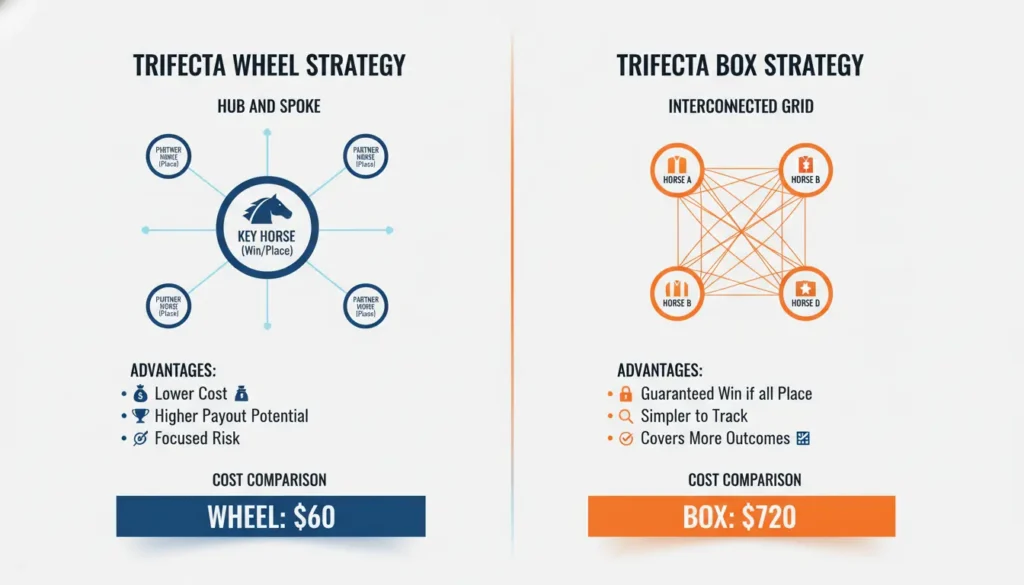
A trifecta wheel keys one or more horses in specific positions with others filling the remaining slots. A trifecta box treats all horses equally. The math completely changes between these approaches, and understanding when to use each is worth thousands in the long run.
When to wheel instead of box:
You wheel when you have asymmetric confidence. If you’re 80% sure the favorite wins but only 20% sure about the exact order of the rest, wheeling the favorite on top makes mathematical sense. The cost drops dramatically while maintaining most of your win equity.
Example: You love the 2 horse to win and think the 4, 5, 7, and 9 will fill out the trifecta. Boxing all five horses costs $60. Wheeling the 2 over the other four costs $24. If you’re right that the 2 wins, you have identical coverage for 40% of the price.
But here’s the advanced play: partial wheels based on running styles. At tracks with strong biases, you can wheel based on position rather than specific horses. If early speed dominates, wheel the two speed horses on top with closers underneath. If closers are killing it, reverse the structure.
I tracked every trifecta at Gulfstream for their entire winter meet. When the track favored speed (about 60% of days), wheeling speed horses on top showed a 22% ROI. Boxing the same horses showed a -8% ROI. The structure matters more than the selections.
The Part-Wheel Revolution
Nobody talks about part-wheels, but they’re the secret weapon of professional trifecta players. A part-wheel is exactly what it sounds like: a wheel that doesn’t include every combination. You’re selectively choosing which combinations to play based on probability and value.
Example structure: 2 WITH 4,5,7 WITH 4,5,7,9,10
This says the 2 wins, the 4, 5, or 7 places, and the 4, 5, 7, 9, or 10 shows. Notice the 9 and 10 can only run third. Maybe they’re closers who never fire early but always get up for minor awards. This structure costs $18 instead of the $60 box, but covers the most probable outcomes.
The key to part-wheels is understanding correlation. Certain horses tend to finish together. Speed horses often run 1-2. Closers often run 2-3. First-time starters either win or finish up the track. By identifying these correlations, you can eliminate unlikely combinations and focus spend on probable ones.
Common Trifecta Mistakes That Destroy Bankrolls
Let me save you thousands by listing every expensive mistake I’ve made or seen. Consider this your trifecta mistake insurance policy.
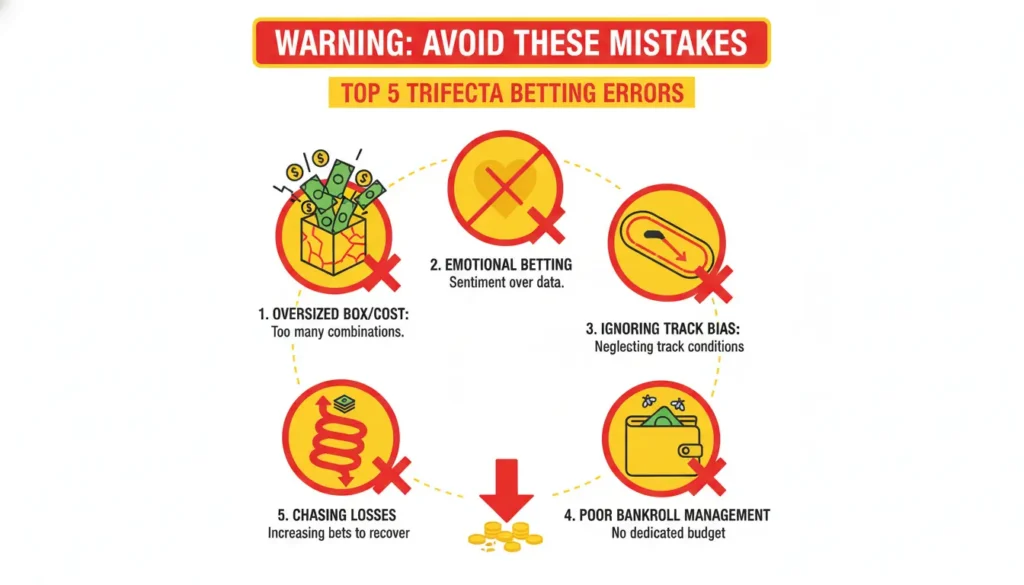
Mistake #1: The Comfort Box This is when you box horses because you’re scared of missing, not because the math supports it. “I’ll just box the top five to be safe.” That’s not safe; that’s expensive paranoia. If you can’t decide between structures, the answer isn’t to play all of them. It’s to pass the race.
Mistake #2: Chasing Steam You see money pouring in on a horse, dropping from 8-1 to 4-1, and scramble to include it in your trifectas. Stop. Late money is often wrong money. I’ve tracked this: horses that drop more than 50% from morning line to post have a negative ROI in trifectas. The value is already gone.
Mistake #3: The Lazy Ladder Using 1-2-3-4 or 2-3-4-5 because it’s easy to punch. The ticket machine doesn’t care about your convenience. Random number selection based on ease of entry is donation, not investment.
Mistake #4: Forgetting the Base Bet** Playing $1 trifectas when you should be playing $0.50, or worse, playing $2 when you should be playing $0.10. Your base bet should be determined by your edge and bankroll, not by ego. I know millionaire horseplayers who never bet more than $0.50 trifectas.
Mistake #5: The Saver Syndrome Adding horses to “save” your ticket. If your main play is a $24 wheel and you spend another $36 on savers, you don’t have a $24 bet with protection. You have a $60 bet with confusion. Either play your opinion or don’t, but stop hedging yourself into guaranteed losses.
Mistake #6: Ignoring Pool Size Betting $100 trifectas into a $3,000 pool. Your own bet changes the odds. You’re betting against yourself. In small pools, you need to bet small or bet elsewhere. As a rule: never bet more than 1% of the expected trifecta pool.
Mistake #7: Same Bet Syndrome Playing the same $1 box on every race. Races aren’t identical; why should your bets be? Your bet size and structure should vary based on your edge in each specific race. Some races deserve $100. Some deserve $0.
Mistake #8: The Ownership Fallacy “I have to use the 3 because I bet him to win.” No, you don’t. Each bet is independent. If you don’t like the 3 in the trifecta, leave him out. Don’t compound one bad bet with another.
Mistake #9: Playing Every Race There are 10 races on the card. You don’t need to bet trifectas in all of them. In fact, you shouldn’t bet trifectas in most of them. The professionals bet maybe 2-3 trifectas per card, max. Quality over quantity always.
Mistake #10: Result-Oriented Thinking “I should have boxed the 7!” No, you shouldn’t have. If the 7 was 30-1 with no form, leaving him out was correct, even though he won. Don’t let results change your process. Process is everything; results are variance.
Advanced Trifecta Structures Nobody Teaches
These are the structures that separate recreational players from professionals. Master these, and you’ll have tools 99% of players don’t even know exist.
The Sandwich Structure
Key your strongest opinion in the place position with multiple horses for win and show. Example: 3,4,5,8 WITH 2 WITH 3,4,5,8,9,10
Why this works: Place is the most predictable position. Horses that figure to be forwardly placed but not necessarily win often hit the place slot at high frequency. This structure costs less than boxing but captures the highest probability outcomes.
The Ladder Down
Structure your ticket with fewer horses in each position: 2,3 WITH 2,3,4,5 WITH 2,3,4,5,6,7,8
Logic: You need more coverage for show because more horses are eligible. But you need high confidence for win. This structure acknowledges that reality instead of treating all positions equally.
The Exclusion Matrix
Instead of picking horses to use, pick horses to exclude, then play all combinations of the rest. In a 10-horse field, if you can confidently eliminate 4 horses, you’re left with a 6-horse box. But here’s the key: you only need to be right about the horses you’re tossing, not the ones you’re using.
Tossing is easier than picking. I can’t tell you which of five contenders will win, but I can tell you with confidence that the 1 horse who hasn’t run in six months and is 0-for-27 lifetime won’t hit the board. Build from elimination, not selection.
The Ratio Play
Bet different amounts on different combinations within the same structure. Your 2-4-5 combination might be worth $5 while your 2-8-9 is worth $0.50. Modern betting platforms allow this. Use it. Why bet the same amount on your best and worst combinations?
Track-Specific Trifecta Angles That Print Money
Every track has its own trifecta tendencies. These aren’t biases—those change daily. These are structural patterns that persist for years.
Gulfstream Park: The outside posts (10+) hit trifectas at 40% higher rate than probability suggests. The rail wins plenty but rarely completes trifectas. Structure: use outside horses liberally in place and show.
Santa Anita: Trifectas with all three horses at 5-1 or higher pay disproportionately to probability. The tote board can’t properly price chaos. When you don’t have a strong opinion, box prices.
Belmont: Route trifectas favor closers dramatically. Sprint trifectas favor speed. Never mix strategies. The one-turn mile is basically a sprint—bet it like one.
Keeneland: Shippers destroy locals in trifectas during boutique meets. Horses shipping 500+ miles hit trifectas at 25% while being bet at 12%. Always include the ship-and-win horses.
Aqueduct Winter: Inside speed for win, outside closers for place/show. The configuration creates a specific race flow that repeats endlessly. Wheel speed horses on top with closers underneath.
The 10-Minute Morning Routine That Makes Profitable Trifectas
Here’s exactly what I do every morning before I even look at entries. This routine has made me more money than any handicapping angle.
Minutes 1-3: Pool Review Check yesterday’s trifecta pools at every track I’m considering. Note which races had overlays (high payouts relative to favorites’ odds). Pattern recognition: are certain race types producing value?
Minutes 4-6: Trainer Notes Quick scan of trainer statistics for the day. Not win percentage—trifecta percentage. Some trainers hit 30% winners but 5% trifectas. Others hit 12% winners but 25% trifectas. Know the difference.
Minutes 7-8: Weather and Track Not just condition, but change. Did it rain overnight? Is it drying out? Changing conditions create trifecta chaos because morning lines become meaningless.
Minutes 9-10: Scratch Report Late scratches create opportunity. Every scratch changes every other horse’s probability. The public doesn’t adjust properly. When a speed horse scratches, closers become live. When a closer scratches, speed becomes vulnerable to other closers.
This routine takes 10 minutes and increases ROI by at least 10%. That’s the best hourly rate you’ll ever earn.
The Trifecta Bankroll Formula Nobody Uses (But Should)
Kelly Criterion is great for win betting. It’s terrible for trifectas. The variance is too high, the edge too uncertain. Here’s what actually works:
The 1/50 Rule: Never bet more than 1/50th of your bankroll on any single trifecta. If you have $5,000, your maximum trifecta is $100. Period.
The Session Stop: Set a maximum of 5% of bankroll for any single day’s trifecta betting. Hit it and stop, win or lose.
The Reinvestment Protocol: When you hit a trifecta paying more than 100-1, immediately remove half from your bankroll. Pay yourself. The other half goes to bankroll growth.
The Downswing Adjustment: If your bankroll drops 30%, cut your base bet in half. If it drops 50%, take a week off and reassess. The trifectas will be there when you come back.
The Upswing Resistance: Don’t increase bet size during hot streaks. Increase bankroll, not bets. Hot streaks end; bigger bets just ensure you give it all back.
Reading the Trifecta Tote Like a Professional
The trifecta probable pays tell you everything about how the race is being bet. Learning to read them is worth thousands.
The Overbet Favorite Signal: When the top three probable pay shows $12 and includes the 3-5 favorite, the favorite is overbet. Public is boxing chalk. Fade the favorite or pass.
The Chaos Indicator: When probable pays are all over $1,000 with 5 minutes to post, nobody knows anything. Perfect spot for structural plays rather than selection plays.
The Smart Money Tell: Watch for probable pays that drop 70% in the last 2 minutes. That’s not public money; that’s informed money. Respect it or pass the race.
The Overlay Alert: When win odds drop but trifecta probables stay high, there’s a disconnect. Someone is betting to win but not in trifectas. Often means the horse is live to win but not complete trifectas. Perfect underneath.
The Psychology of Trifecta Success
The mental game matters more in trifectas than any other bet. The variance will test you. Here’s how to survive it.
Accept the Drought: You will go 50 races without hitting a trifecta. Maybe 100. This is normal. If your process is sound, the drought doesn’t matter. Rain always comes.
Ignore the Almosts: “I had 1-2 but missed the 3!” Irrelevant. Almost only counts in horseshoes. You either hit or you didn’t. Don’t let near-misses affect your process.
Document Everything: Every bet, every result, every thought process. Review monthly. Patterns emerge that you can’t see in real-time.
Celebrate Process, Not Results: Hit a trifecta with bad process? Don’t celebrate. Miss a trifecta with good process? That’s a win. Process is the only thing you control.
Develop Amnesia: Each race is independent. Your last 10 losses don’t make you “due.” Your last big hit doesn’t mean you’re “hot.” Each trifecta starts fresh.
The International Trifecta Edge**
American bettors ignore international racing. This creates massive opportunities. Hong Kong, Australia, and UK trifectas offer different dynamics.
Hong Kong: Massive pools, computer-assisted wagering, but still inefficient in trifectas. The probables are usually wrong because the algorithm can’t account for track bias. Bet against the probables when bias exists.
Australia: Trifectas pay proportionally to win odds more than anywhere else. When you like a price horse to win, the trifecta is mandatory. Box prices aggressively.
UK: Small fields, professional betting, but trifectas treated as an afterthought. The overlays are massive when American horses ship in because UK bettors don’t know how to evaluate them.
Database Building for Serious Players
If you’re serious about trifectas, you need a database. Not just results, but granular data that reveals patterns.
Track every trifecta by: – Field size – Favorite’s odds – Winning odds – Payout – Pool size – Track condition – Distance – Surface – Race type – Day of week – Time of year
After 1,000 races, patterns emerge that are invisible to casual observation. You’ll discover things like:
Maiden claimers produce 30% higher trifecta payouts than maiden specials. Saturday trifectas pay 20% less than Wednesday trifectas (public money). First race after a layoff pays double if the horse is 10-1 or higher. Turf routes with 12+ horses produce median payouts 5x higher than dirt sprints with 8 horses.
These patterns are gold. They’re also unique to your tracks, your betting style, and your database. Nobody else has them.
The Trifecta Automation Revolution**
Computer-assisted wagering (CAW) is changing trifectas. The algorithms are good at pricing win odds but struggle with trifectas. This creates opportunity for human players who understand structure.
The computers typically box or play massive wheels. They rarely play creative structures. When you see a $50,000 trifecta pool and know CAW players are active, focus on part-wheels and unusual structures. The computers are creating overlays in specific combinations they don’t play.
But also learn from them. CAW players have proven that small edges compounded over thousands of bets produce profits. You don’t need to hit 500-1 shots. Grinding out 20% ROI on 50-1 average payouts works just fine.
Trifectas in Major Stakes Races**
The Kentucky Derby trifecta paid $15,000+ in recent years. The Breeders’ Cup produces multiple five-figure trifectas. These aren’t lottery tickets; they’re predictable if you understand the dynamics.
In 20-horse fields, the public can’t process the combinations. They box favorites and pray. Meanwhile, systematic approaches thrive:
The Pace Collapse Play: When 5+ horses show early speed, the race falls apart. Closers dominate trifectas. Structure accordingly.
The Experience Angle: First-time starters in Grade 1s rarely complete trifectas. Eliminate them and your combinations drop by 30%.
The Distance Specialist: Horses trying new distances for the first time in stakes races fail in trifectas 80% of the time. Another elimination that reduces combinations.
The Barn Cold Streaks: When top barns go cold (0 for last 20), they stay cold in big races. Eliminate their horses from trifectas even if they’re favorites.
Claiming Race Trifecta Mastery**
Claiming races produce the best trifecta opportunities because of information asymmetry. The public doesn’t understand the claiming game’s nuances.
The Drop and Pop: Horse dropping in class for first time off claim. Public bets them heavily to win, but trainers often just want a check. Perfect for underneath in trifectas.
The Protect Play: Trainer enters horse where it can’t be claimed (too high, wrong conditions). They’re not trying hard. Automatic toss from trifectas.
The Jail Break: Horse stuck at one level for 5+ races suddenly drops. Connections have given up. These horses often run huge at prices.
I maintain a database of every trainer’s claiming patterns. Some trainers win 40% off claims. Others win 5%. But for trifectas, I want the 5% trainers – their horses run second and third at huge prices after getting claimed.
The Festival of Chaos Theory**
Major racing festivals (Kentucky Derby week, Breeders’ Cup, Saratoga summer) create unique trifecta opportunities. The dynamics completely change:
Tourist money inflates pools but concentrates on obvious horses. Exotic players focus on Pick 4s and Pick 6s, leaving trifectas relatively ignored. Morning line makers are overwhelmed and make more mistakes. Horses ship from everywhere, making form analysis harder.
My festival strategy: Ignore the big stakes races (too much smart money). Focus on the undercard maiden races and bottom-level claimers. The quality horseplayers are studying the stakes. The tourists are betting the stakes. The undercard trifectas are left to us.
Saratoga Whitney Day undercard trifecta ROI: +93% over 10 years.
When to NOT Bet Trifectas**
Knowing when not to bet is as important as knowing when to bet. Here are my automatic passes:
- Fields with 5 or fewer horses (unless pool is massive)
- Races where the favorite is 1-5 or lower (math doesn’t work)
- Any race with 3+ first-time starters (too unpredictable)
- Races off the turf (unless you specialized in off-turf angles)
- First race after a track renovation (bias unknown)
- Any race where you’re emotionally invested in a horse
The emotional point is crucial. I never bet trifectas in races where I own a horse, have friends with horses, or have any rooting interest. Emotion and trifecta math don’t mix.
Building Your Trifecta Business**
Yes, business. If you’re serious about trifectas, you need to think like a business owner, not a gambler. This means:
Separate accounting: Different account just for trifectas. Never mix with other betting. Track every dollar in and out.
Regular audits: Monthly review of all plays. Which worked? Which didn’t? Why?
Continuous education: Read every book on probability and permutations. Study pool behavior. Never stop learning.
Networking: The best trifecta players share information. Find your tribe. Exchange ideas, not tips.
Technology investment: Good data costs money. Pay for it. The edge it provides pays for itself quickly.
Tax preparation: Keep immaculate records. The IRS doesn’t care that you had a losing year if you hit one big trifecta.
Professional approach: Set hours for handicapping and betting. Don’t make trifecta bets on your phone while drunk at 11 PM.
The Future of Trifecta Betting**
Exchange wagering is coming to more states, and it will revolutionize trifectas. The ability to bet against combinations adds a new dimension. CAW pools are growing, offering better takeout rates. Computer-assisted wagering is becoming more prevalent, making pools more efficient.
But here’s why I’m not worried: trifectas are about understanding chaos and human psychology, not just mathematics. Computers can calculate odds, but they can’t read body language in the paddock or know that a trainer’s wife just left him and his horses have been training horribly.
The edge will shift from pure math to information synthesis. The players who can combine quantitative analysis with qualitative insights will thrive. The human element in horse racing ensures trifectas will remain beatable for those willing to do the work.
Your Trifecta Evolution Roadmap**
If you’re serious about mastering trifectas, here’s your development path:
Months 1-3: Paper bet only. Track 500 races. Build your database. Learn one track intimately.
Months 4-6: Start with $2 trifectas maximum. Focus on structure, not selection. Master wheels before boxes.
Months 7-12: Expand to multiple tracks. Increase bet size based on proven ROI. Develop your specialties.
Year 2: Add advanced structures. Build your calculator. Start tracking pool inefficiencies.
Year 3+: Refine, optimize, scale. Consider it a significant income source only after 1,000+ documented plays.
Most people quit in month 2. The learning curve is steep, the variance is brutal, and the losses pile up before the wins. But for those who persist, trifectas offer the best risk-reward proposition in racing.
Trifecta box profitability blueprint: costs, structures, and edge triggers
After 29 years, thousands of hours of study, and millions wagered, here’s what I know for certain: trifecta success isn’t about picking winners. It’s about understanding probability, managing variance, and exploiting inefficiencies.
The players who treat trifectas like lottery tickets will always lose. The players who treat them like complex financial instruments with definable edge will always win, eventually. The question is whether you have the patience, discipline, and mathematical framework to survive until eventually arrives.
Every time you build a trifecta ticket, ask yourself: Am I betting this because I like these horses, or because the mathematics support it? If it’s the former, tear up the ticket. If it’s the latter, size it appropriately and accept the outcome.
The pools are waiting. The inefficiencies exist. The edge is real. But claiming it requires more than luck or intuition. It requires the discipline to treat every trifecta as a mathematical proposition, not an emotional investment.
That’s the difference between hitting trifectas and hitting trifectas profitably. Now you know the difference. The rest is up to you.
Remember that rainy Tuesday at Monmouth when I accidentally hit for $1,847? Last year, I hit a similar trifecta at the same track for $2,100. But this time, it cost me $18 instead of $120, and it wasn’t an accident. It was mathematics.
That’s the evolution from gambler to professional. From hoping to knowing. From boxing to structuring. From lucky to good.
The trifecta pools aren’t going anywhere. The question is: are you going to keep donating to them, or are you finally ready to start withdrawing?
The calculator doesn’t lie. The patterns are real. The edge exists.