
Bookmaker Margins Explained What Is the Vig
 Available in US

Bookmakers are not in the business of gambling. Despite appearances, they have no interest in predicting winners or taking sides in sporting contests. Their business model is far more elegant and far less risky: they act as intermediaries who facilitate bets between different parties while extracting a guaranteed percentage for themselves. This extraction mechanism goes by many names – the vig, the vigorish, the juice, the margin, the overround – but they all describe the same fundamental concept. It is the hidden cost embedded in every bet you place, and understanding it is essential for anyone serious about sports betting.
The existence of the margin explains why betting is a negative-sum game for punters as a collective. Every dollar wagered eventually returns less than a dollar on average because the bookmaker siphons off their cut regardless of which outcome prevails. This is not cheating or manipulation – it is simply the cost of the service. Bookmakers provide liquidity, manage risk, and create markets where none would otherwise exist. The margin is their payment for doing so. Your job as a bettor is to understand how large this payment is and to minimise it wherever possible.
The practical implications of margin are profound. A seemingly small difference between bookmakers – say, one offering 1.90 odds versus another offering 1.95 on the same outcome – represents a meaningful difference in your expected returns over time. Bettors who ignore margin are essentially paying a higher tax on every wager. Those who actively seek low-margin bookmakers and markets give themselves a better chance of long-term profitability. The margin is invisible unless you know how to calculate it, which is precisely why most recreational bettors never consider it.
Table of Contents
How the Margin Works
Consider the simplest possible betting scenario: a coin toss. In a fair world, the probability of heads is exactly 50%, and the probability of tails is exactly 50%. Fair odds would therefore be 2.00 on both outcomes – you risk one unit to win one unit, reflecting the true 50/50 nature of the event. If you bet on heads repeatedly at fair odds, you would theoretically break even over time, winning half and losing half.
Bookmakers have no interest in offering fair odds because fair odds generate zero profit. Instead of 2.00 on both outcomes, they might offer 1.91 on heads and 1.91 on tails. Now, when you convert these odds to implied probabilities, something interesting happens. Odds of 1.91 imply a 52.4% chance of occurring. But wait – if both heads and tails each have a 52.4% implied probability, the total comes to 104.8%. In reality, probabilities can only sum to 100%, so that extra 4.8% represents the bookmaker’s built-in edge.
This excess beyond 100% is called the overround or margin. It guarantees the bookmaker a profit regardless of which outcome occurs, provided they attract roughly balanced action on both sides. If $100 is wagered evenly – $50 on heads and $50 on tails – the bookmaker collects $100 but pays out only $95.50 to the winner (stake plus winnings at 1.91 odds). The remaining $4.50 is profit, representing about 4.5% of the total handle. This profit is mathematically locked in before the coin even leaves the flipper’s thumb.
The margin works identically in more complex markets with three or more outcomes. A football match with home win, draw, and away win options might show odds of 2.10, 3.40, and 3.60 respectively. Converting each to implied probability: home win is 47.6%, draw is 29.4%, and away win is 27.8%. Adding these together gives 104.8% – the same overround as our coin toss example. The bookmaker has priced the market to guarantee approximately the same profit margin regardless of result.
Calculating Overround and Vig
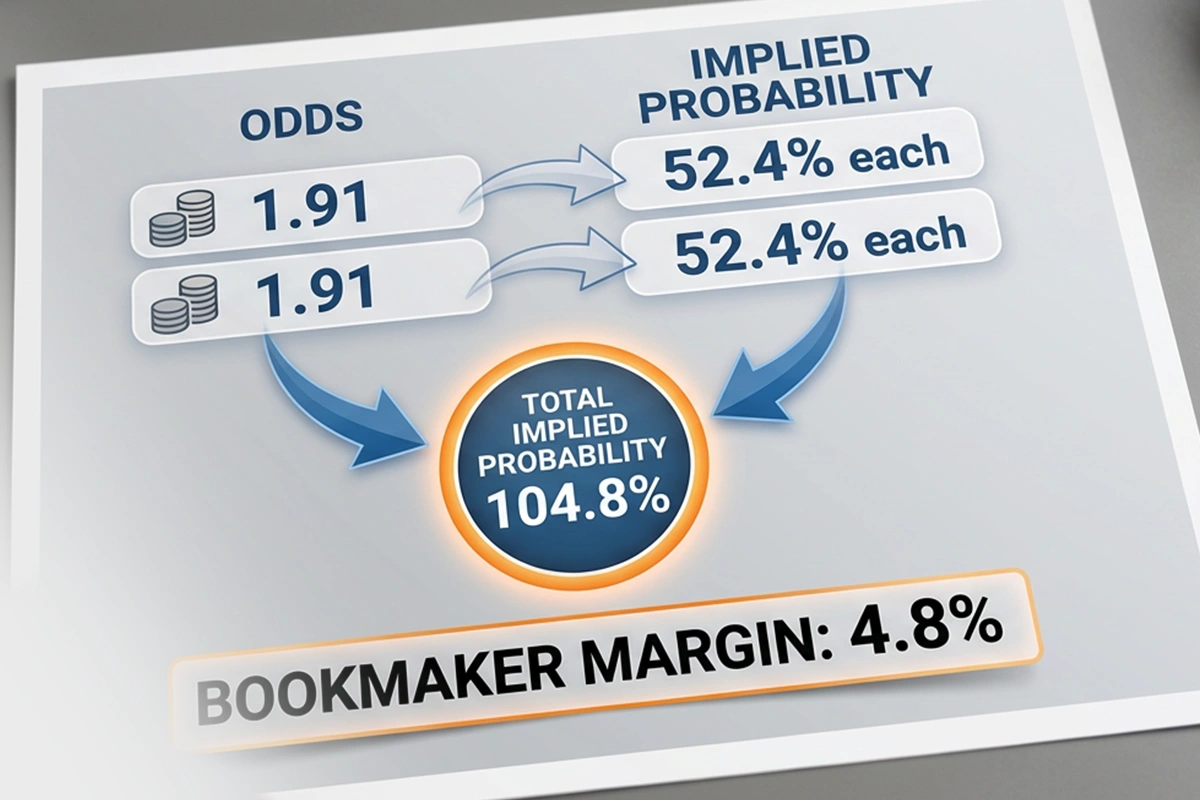
The calculation is refreshingly straightforward. Take the decimal odds for every possible outcome in a market, convert each to implied probability by dividing 1 by the odds, then sum those probabilities. If the total exceeds 100%, the excess is the bookmaker’s margin.
For a two-way market: Margin = (1/Odds A) + (1/Odds B) – 1
For a three-way market: Margin = (1/Odds A) + (1/Odds B) + (1/Odds C) – 1
Using a practical example, imagine a tennis match with odds of 1.65 on Player A and 2.35 on Player B. The implied probabilities are 60.6% and 42.6% respectively, totalling 103.2%. Subtracting 100%, we find the bookmaker’s margin is 3.2%. This means that if you were to bet proportionally on both outcomes, you would expect to lose about 3.2% of your stake over time.
The term “vig” or “vigorish” is often used interchangeably with margin, though technically they represent slightly different calculations. The vig measures the bookmaker’s profit relative to total turnover, while margin measures profit relative to payouts. For practical purposes as a bettor, the distinction matters less than simply understanding that both represent the cost extracted from your wagers. An overround of 105% corresponds roughly to a 4.5-5% vig on your stake.
When evaluating bookmakers or specific markets, lower overround is always better for bettors. A market running at 102% overround means you lose about 2% on average, while a market at 110% means you lose about 10%. The difference is enormous over hundreds of bets. Elite betting exchanges like Betfair operate with margins as low as 1-2% on popular markets, while some recreational bookmakers push margins to 8% or higher on the same events. Choosing where you bet matters almost as much as choosing what you bet on.
Why Margins Vary
Not all betting markets carry the same margin, and understanding why helps you find better value. Several factors influence how much juice a bookmaker builds into their odds.
Market liquidity and competition play a massive role. Premier League football matches, NFL games, and major tennis tournaments attract enormous betting volumes and fierce competition between bookmakers. To win business, operators sharpen their odds, reducing margins to attract sharp money. A typical Premier League match result might carry only a 3-4% margin with competitive bookmakers. Contrast this with a fourth-tier Portuguese football match, where the same bookmaker might run 8-10% margins because competition is minimal and the risk of pricing errors is higher.
The number of possible outcomes affects margin as well. A two-way market (like a tennis match) naturally allows for tighter margins than a 20-runner horse race. Each additional outcome provides the bookmaker another opportunity to build in margin, and the compounding effect is significant. Individual horse race winner markets regularly show overrounds of 115-140%, compared to head-to-head markets at 102-105%.
Time until the event influences pricing. Markets opened weeks before a match typically carry higher margins than those available hours before kickoff. As the event approaches, more information becomes available, public betting patterns reveal themselves, and bookmakers feel comfortable tightening their prices. Sharp bettors often wait until close to post time for the best odds on major events, while recreational punters betting early pay a premium for the privilege.
The bookmaker’s business model determines their overall approach to margin. Some operators target recreational bettors with aggressive marketing, generous bonuses, and higher margins to fund these activities. Others, like Pinnacle, deliberately welcome professional bettors by offering the lowest possible margins without promotions. The trade-off is explicit: low-margin bookmakers offer better odds but no freebies, while high-margin operators disguise their inferior prices behind flashy offers.
The Impact on Your Bottom Line
Understanding margin transforms how you think about betting value. Most bettors focus entirely on picking winners, but even successful selection does not guarantee profit if the margin is too high. You need to overcome the bookmaker’s edge before you can generate any return.
Consider the mathematics. With standard -110 American odds (roughly 1.91 decimal) on even-money propositions, you need to win approximately 52.4% of your bets to break even. The 2.4% gap between 50% (chance) and 52.4% (required win rate) represents the margin you must overcome. Every percentage point of additional margin requires another percentage point of accuracy to compensate.
If you bet exclusively with low-margin bookmakers offering 1.97 on even-money events, your breakeven win rate drops to about 50.8%. That 1.6% difference might seem trivial, but over 1,000 bets it represents the difference between losing money and being a profitable bettor. Sharp bettors understand that edge comes from everywhere – selection quality, timing, stake sizing, and yes, finding the lowest available margin.
The impact compounds dramatically for accumulators and parlays. Margin is applied to each leg independently, so a four-leg parlay at a 5% margin bookmaker faces an effective combined margin of roughly 21.5%. The astronomical payouts advertised for accumulators obscure this reality. Bookmakers promote parlays enthusiastically precisely because the compounded margin makes them extraordinarily profitable.
Strategies for Minimising Margin Cost

The most effective strategy is also the simplest: maintain accounts with multiple bookmakers and always shop for the best available price. A match might show 2.10 at Bookmaker A, 2.15 at Bookmaker B, and 2.20 at Bookmaker C. Taking the best price is free edge that requires no analytical skill whatsoever. Over time, consistently getting 2.20 instead of 2.10 makes a substantial difference to your results.
Betting exchanges deserve special attention. Unlike traditional bookmakers, exchanges merely match bettors against each other and take a small commission on winnings – typically 2-5% of profit rather than 4-8% built into the odds. The net result is that exchange odds are frequently superior, especially for popular markets where liquidity is sufficient to find counterparties. The lay function (betting against outcomes) also creates opportunities impossible with traditional bookmakers.
Focus your betting on markets where competition drives margins down. Major leagues, major tournaments, and heavily followed sports offer the best odds. Niche markets might seem attractive because less public attention theoretically means more opportunity for edge, but this potential is often offset by wider margins that eat into any advantage you might find.
Avoid proposition bets and exotic markets unless your edge is substantial. Bookmakers price these with far higher margins because they know casual bettors are drawn to the novelty and rarely check the numbers. A player prop with 8% margin requires you to be significantly more skilled than one with 3% margin – and most bettors overestimate their ability to find edge in unfamiliar markets.
Finally, resist the temptation to evaluate bonuses without considering the underlying odds quality. A 100% deposit match sounds generous until you realise the bookmaker recaptures that money through inferior prices over your betting lifetime. Calculate the actual value of promotions relative to how much extra margin you will pay, and you might find that “bonus-free” low-margin bookmakers offer better overall value.
The vig is the unavoidable friction in sports betting. You cannot eliminate it entirely, but you can minimise its impact through informed choices about where and how you bet. Every percentage point saved on margin goes directly to your bottom line – not to the bookmaker’s shareholders.