
How Bookmakers Set Odds Behind the Scenes
 Available in US

The odds you see on your betting slip are not plucked from thin air, nor are they the product of a bookmaker’s gut feeling about who might win. Modern odds compilation is a sophisticated blend of statistical modelling, market intelligence, and real-time adjustment that would not look out of place in a financial trading operation. Understanding how this process works gives bettors valuable insight into where opportunities might exist and why certain prices move the way they do. Find more guides on reading lines on our home page.
Bookmakers are not in the business of predicting winners. This distinction matters enormously. Their goal is to set prices that attract balanced action on all outcomes while embedding a profit margin that guarantees returns regardless of the result. A perfectly balanced book means the bookmaker pays out winners using money collected from losers, keeping the margin as profit. Whether Team A or Team B wins is fundamentally irrelevant to a bookmaker who has successfully balanced their exposure. This is why the best odds compilers think like traders rather than tipsters.
The evolution from human intuition to algorithmic precision has transformed the industry over the past two decades. Where once a room full of experienced traders would manually price every market based on form analysis and memory of past betting patterns, today’s operations rely heavily on mathematical models and automated systems. Human expertise remains valuable for edge cases and quality control, but the heavy lifting is done by algorithms processing vast datasets in real time.
Table of Contents
The Starting Point: Probability Assessment
Every price begins with an estimate of true probability. Before margin is applied or market forces considered, odds compilers need to determine the actual likelihood of each possible outcome. This foundational step draws on multiple data sources and methodologies depending on the sport and market in question.
For football, the Poisson distribution has become the industry standard for modelling match outcomes. This statistical model uses expected goal rates for each team to simulate thousands of potential match results, generating probability distributions for home wins, draws, and away wins. The inputs – attack strength, defence weakness, home advantage adjustments – come from historical performance data weighted by recency. A team’s performance last week matters more than their performance last season, but both contribute to the calculation.
The quality of input data directly determines the quality of the output odds. Top bookmakers invest heavily in data feeds covering everything from basic match statistics to advanced metrics like expected goals, pressing intensity, and player tracking data. For popular leagues, the data is comprehensive and the resulting probabilities are highly accurate. For obscure competitions, data scarcity creates uncertainty that bookmakers compensate for by widening margins.
Tennis and basketball use different models suited to their scoring systems. Tennis odds might rely on surface-adjusted Elo ratings and historical head-to-head data. Basketball models incorporate pace factors, offensive and defensive efficiency ratings, and rest day advantages. Each sport has its own mathematical language, and odds compilers become specialists in translating that language into probabilities.
Beyond pure statistical models, compilers factor in contextual information that numbers alone cannot capture. Is this match a cup final or a meaningless end-of-season fixture? Are key players injured, suspended, or likely to be rested? What are the weather conditions? Does the referee have a history of affecting certain outcomes? These qualitative factors adjust the base probability up or down, often based on accumulated institutional knowledge about how such factors historically influence results.
The Margin Application
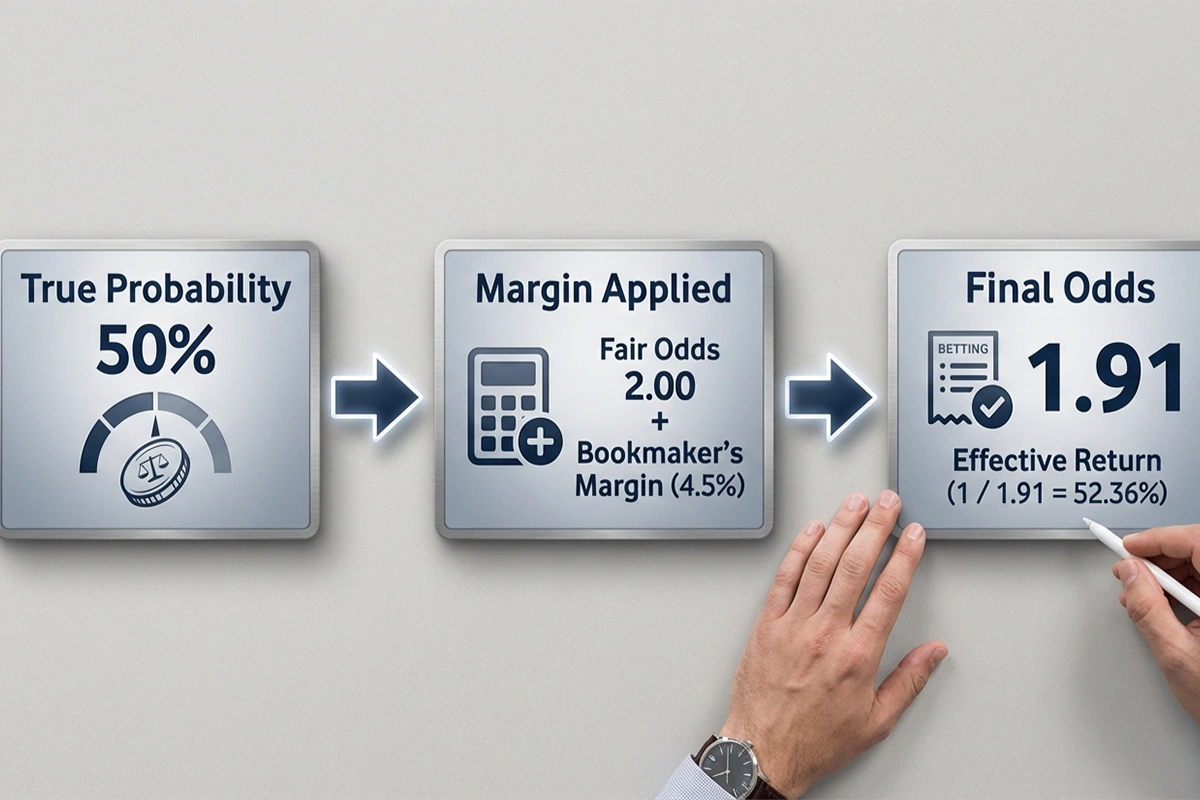
Once true probabilities are estimated, the bookmaker applies their margin to convert fair odds into profitable odds. If the model suggests a 50% chance for each outcome in a two-way market, fair decimal odds would be 2.00 on both sides. But no bookmaker offers fair odds – they might instead offer 1.91 on both outcomes, building in approximately 4.5% margin.
The margin is not applied uniformly across all outcomes. Research consistently shows that bookmakers take more margin from longshots than from favourites, a phenomenon known as favourite-longshot bias. A 10/1 underdog might be priced at 9/1, losing 10% of its fair value, while a 1/2 favourite might be priced at 4/9, losing only 3% of its fair value. Whether this reflects bookmaker strategy or public betting patterns is debated, but the effect is well-documented.
Different bookmakers apply different margin levels based on their business models. Recreational-focused operators like Bet365 or William Hill typically run higher margins (4-6% on major football) but offer bonuses and promotions to compensate. Sharp-focused operators like Pinnacle run minimal margins (2-3%) but offer no promotions and actively welcome winning bettors. Betting exchanges like Betfair charge commission on winnings rather than building margin into prices, often resulting in the best available odds.
The margin also varies by market and sport. Main match result markets carry smaller margins than proposition bets or exotic markets. Premier League football carries smaller margins than Portuguese third division. In-play betting typically carries higher margins than pre-match prices because the bookmaker faces greater uncertainty and faster information flow. Understanding where bookmakers apply their margin helps bettors identify which markets offer the best value.
Market Opening and Price Discovery
The opening line represents the bookmaker’s initial opinion, but it is far from their final word. Odds go live knowing they will evolve based on incoming information – both from the betting public and from the wider market.
Sharp bookmakers like Pinnacle deliberately open markets with low limits and relatively soft lines, inviting knowledgeable bettors to bet into the market. When sharp money lands on one side, the price adjusts to reflect this new information. This process, called price discovery, treats early betting as a form of crowd-sourced intelligence. If multiple sharp bettors independently identify value on the same side, the odds move quickly to eliminate that value.
Many recreational bookmakers do not engage in price discovery themselves. Instead, they monitor the prices at sharp bookmakers and adjust their own lines to match. This practice, called “following Pinnacle,” means that the odds at your local bookmaker often originate from a trading floor in Malta or Curacao. The recreational bookmaker adds their own margin on top and waits for the bets to flow in.
The timing of line movements reveals information to observant bettors. To beat the bookmaker, tracking line movement is essential. A price that shortens dramatically in the hours before kickoff suggests significant sharp action. A price that stays stable despite heavy recreational betting suggests the bookmaker expected that money and had already balanced for it. Reading these movements is an art that some profitable bettors specialise in, looking not at what they think will happen, but at what the market believes.
Real-Time Adjustment
Once a market opens, it becomes a living entity that responds to incoming information. The trading team monitors multiple factors simultaneously and adjusts prices accordingly.
Money flow is the primary driver of price changes. If 70% of stakes land on one outcome, the bookmaker faces unbalanced exposure that could result in significant losses. They respond by shortening the odds on the popular selection (making it less attractive) and lengthening the odds on the unpopular side (making it more attractive). This process naturally pushes money toward balance, or at least reduces the bookmaker’s potential downside.
News events trigger immediate adjustments. A starting lineup announcement that reveals an injured star player absent forces rapid repricing. Weather changes that favour one team over another must be incorporated. Tactical information gleaned from press conferences might move the market. Trading teams monitor news feeds continuously, and automation allows instantaneous response to structured data like official team sheets.
Competitor prices influence adjustments as well. If a bookmaker’s price diverges significantly from the market consensus, they attract arbitrage activity and sharp betting that exploits the discrepancy. Most operators therefore keep their prices within a narrow band of the market, adjusting when competitors move rather than waiting for their own money flow to dictate changes.
In-play betting accelerates all of these dynamics. During a match, prices change every few seconds in response to on-field events. A goal, a red card, an injury – each triggers automated repricing based on how the new situation affects expected outcomes. The algorithms running in-play markets are far more complex than pre-match models, incorporating time decay, current scoreline, momentum indicators, and dozens of other variables.
The Sharp-Square Divide
Bookmakers categorise bettors as “sharps” (professionals whose opinions carry weight) or “squares” (recreational bettors whose opinions do not). This distinction profoundly affects how they respond to money.
When a known sharp bettor places a large wager, the bookmaker pays attention. Sharps have track records of beating the closing line and winning over time. Their bets represent informed opinion that the bookmaker’s price may be wrong. In response, the bookmaker adjusts the odds to reflect this new information. A £10,000 bet from a sharp might move the line by a full point, while £10,000 from a casual punter might not move it at all.
Square money matters for liability management but not for price discovery. If thousands of England fans bet on their team to win the World Cup, the bookmaker shortens England’s odds not because they believe England became more likely to win, but because they need to reduce exposure. This creates potential value on the opposing side, as the price is moving for commercial rather than informational reasons.
Some sharp bettors exploit this dynamic by betting against heavy public action. When recreational money pushes a favourite’s price below fair value, the contrarian bettor takes the inflated odds on the underdog. This strategy requires patience and tolerance for losing more often than winning, but the mathematics favour it when public bias is strong enough.
Where Opportunities Exist

Understanding odds compilation reveals where bookmakers are most and least vulnerable. Markets with abundant data, high liquidity, and intense sharp scrutiny – like Premier League match results – are priced extremely efficiently. Finding systematic edge in these markets is difficult because any inefficiency is quickly arbitraged away.
Less efficient markets exist where bookmakers have informational disadvantages. Lower league football, niche sports, and markets with fewer betting options attract less sharp money, meaning price discovery is incomplete. A bettor with genuine expertise in Norwegian second division or women’s handball may find persistent value that would not exist in mainstream markets.
In-play betting offers another avenue. The speed of odds adjustment during matches sometimes lags behind reality. A bettor watching a game live might recognise a momentum shift before the algorithm does, or notice that a key player is carrying an injury before it becomes official news. These windows are brief, but they exist.
New and exotic markets also present opportunities. When bookmakers introduce novel betting options – like politics markets or entertainment props – they lack historical data to price them accurately. Early movers who understand these areas better than the compilers can find value until the market matures.
The fundamental truth is that bookmakers are very good at their job but not perfect. They make mistakes, they react slowly to certain information, and they sometimes prioritise liability management over accurate pricing. Bettors who understand how odds are set can look for these imperfections rather than betting blind against a well-oiled machine.