
Finding Value in Betting Odds The Expected Value Approach
 Available in US

The fundamental question separating profitable bettors from losing ones is not “who will win?” but “is this bet priced correctly?” Recreational bettors chase winners, picking teams they believe will prevail and hoping for the best. Professional bettors hunt for value, identifying situations where the odds offered exceed the true probability of an outcome. This conceptual shift – from prediction to valuation – transforms sports betting from gambling into something resembling investment.
Expected value provides the mathematical framework for this approach. Explore all mathematical tools on the MyBoxBet platform. Every bet carries an expected value, positive or negative, that represents its long-term profitability if placed repeatedly. A bet with positive expected value (+EV) profits over time regardless of short-term results. A bet with negative expected value (-EV) loses money over time even if it occasionally wins. The bookmaker’s margin ensures that most available bets carry negative expected value, but inefficiencies exist, and finding them consistently is the path to sustainable profit.
Value betting requires accepting a counterintuitive truth: you will sometimes bet on teams you expect to lose, because the odds compensate sufficiently for that losing probability. A team with 35% chance of winning at +300 odds represents better value than a team with 55% chance of winning at -150 odds. The former has positive expected value; the latter does not. Detaching from the desire to “pick winners” and focusing instead on price versus probability is the essential mindset shift.
Table of Contents
Understanding Expected Value
Expected value quantifies what a bet is worth on average over the long run. The formula is straightforward: multiply each possible outcome by its probability and sum the results. For a simple bet, this becomes: EV = (probability of winning x profit if you win) – (probability of losing x stake if you lose).
Consider a coin flip at even money (+100 odds). You risk $100 to win $100. The expected value is: (50% x $100) – (50% x $100) = $0. This is a fair bet with zero expected value – neither you nor the bookmaker has an advantage. In reality, bookmakers would offer this at -110 both sides, creating negative expected value for bettors and positive expected value for themselves.
Now imagine the same coin flip offered at +120 on heads. The expected value becomes: (50% x $120) – (50% x $100) = $10. For every $100 bet at these odds, you expect to profit $10 on average. This is a 10% positive expected value bet – extraordinarily valuable in sports betting terms. Professional bettors typically work with edges of 1-5%, making a 10% edge remarkable.
The challenge is that unlike coin flips, true probabilities in sports are unknown. You cannot observe that a team has exactly 57.3% chance of covering the spread. You must estimate probability through analysis, modeling, or comparison with sharp market prices. The accuracy of your probability estimates directly determines whether your perceived +EV bets are actually profitable.
Calculating Expected Value in Practice
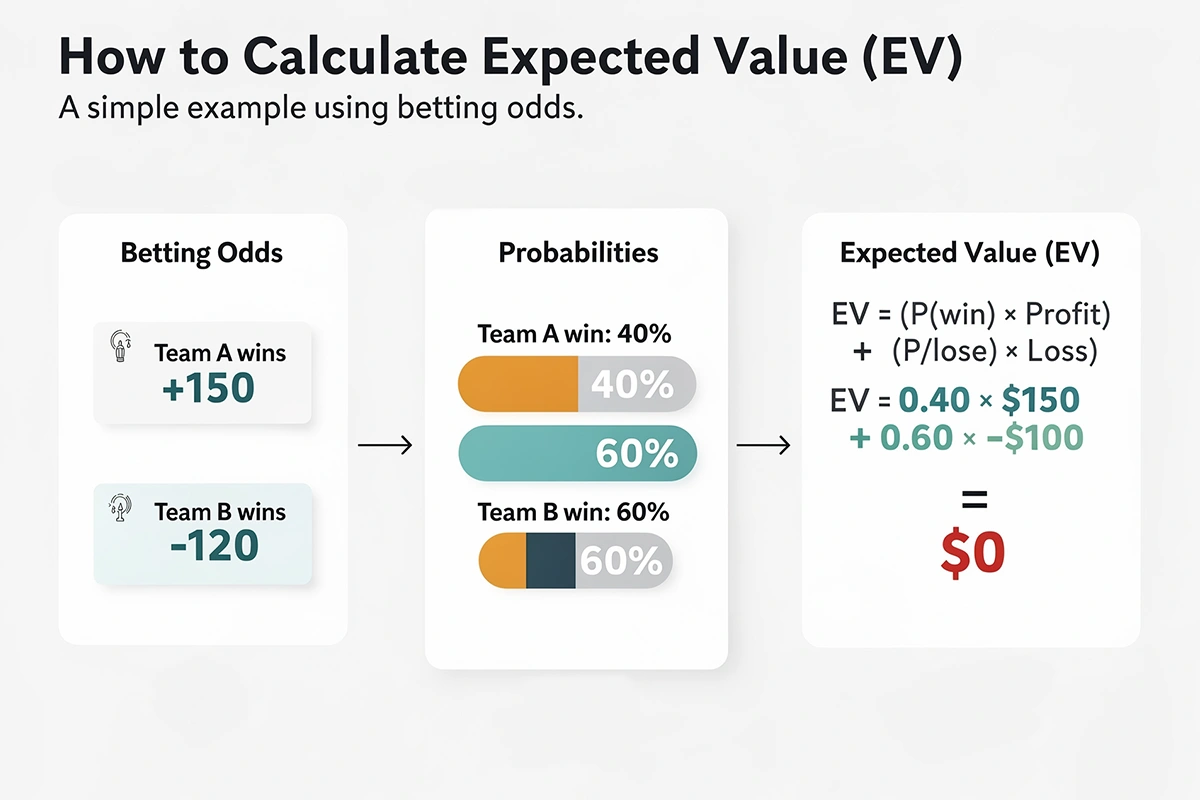
Converting betting odds to implied probability is the first step. You can’t find positive EV without understanding implied probability. For decimal odds, divide 1 by the odds. For American odds, the formulas differ for positive and negative numbers. Positive odds: 100 / (odds + 100). Negative odds: |odds| / (|odds| + 100). A -150 favourite implies approximately 60% probability; a +200 underdog implies approximately 33%.
The bookmaker’s margin inflates these implied probabilities beyond 100%. If one side is -150 (60% implied) and the other is +130 (43.5% implied), the total is 103.5% – the 3.5% excess represents the bookmaker’s edge. To find “fair” probabilities, you must remove this margin through a process called devigging.
Sharp sportsbooks like Pinnacle operate with minimal margins on major markets. Their prices, after removing the small remaining vig, approximate true market probabilities. Many value bettors use Pinnacle’s devigged lines as their baseline for fair odds, then compare other bookmakers’ prices to identify discrepancies.
Expected value calculation becomes: compare your assessed probability (or devigged sharp book probability) to the implied probability of your available odds. If your probability estimate exceeds the breakeven threshold, the bet is +EV. At -110 odds, you need 52.4% win probability to break even. If you estimate 55% true probability, the bet has approximately 2.5% expected value.
Sources of Value
Value arises whenever a bookmaker’s price does not accurately reflect true probability. Several systematic sources create these opportunities.
Slow line movement at recreational sportsbooks creates windows where their odds lag behind sharp market consensus. When Pinnacle moves a line from -3 to -4, recreational books might still offer -3 for minutes or hours. Betting the stale line captures value before the book adjusts. This edge evaporates quickly as markets become more efficient.
Market-specific inefficiencies exist in less liquid betting markets. Major NFL spreads are priced efficiently because enormous betting volume reveals the true line. Player props, lower-tier leagues, and exotic markets receive less attention and thus contain more pricing errors. Sharp bettors often specialise in these inefficient markets where edges persist longer.
Information advantages provide value when you possess relevant knowledge before the market incorporates it. Injury information, lineup changes, weather developments, or tactical insights can give you an edge if you act before prices adjust. This requires both information sources and the ability to quickly assess their betting implications.
Model-based edges come from systematic analysis that identifies mispriced situations. Building statistical models that predict outcomes better than the market consensus – even marginally – creates sustainable edge. This is how professional betting syndicates operate: proprietary models generating probability estimates, then comparing those estimates to available odds to find +EV opportunities.
Public bias exploitation captures value from predictable recreational betting patterns. The public overvalues favourites, popular teams, recent form, and high-profile matchups. Systematically fading these tendencies – betting underdogs, unpopular teams, and low-profile games – has historically generated positive returns because the betting action from casual money pushes prices away from true value.
The Long-Term Perspective
Expected value is a long-run concept that provides no guarantees about individual bets. A +5% EV bet still loses frequently; a -3% EV bet still wins sometimes. The mathematical edge only manifests over hundreds or thousands of wagers, as actual results converge toward expected results through the law of large numbers.
This creates a psychological challenge. A bettor placing legitimate +EV wagers might lose money for weeks or months due to variance. Short-term results provide almost no information about whether the strategy is working. Only extended sample sizes – typically 500+ bets minimum – reveal whether perceived edges are real or imagined.
Variance in sports betting is substantial. Even skilled bettors with genuine edge experience significant drawdowns. A professional hitting 54% of -110 bets (a strong long-term edge) might easily go 45-55 over a 100-bet sample through pure variance. Maintaining discipline through losing stretches, trusting your process when results are poor, is perhaps the most difficult aspect of value betting.
Tracking closing line value (CLV) provides faster feedback than waiting for results. If you consistently bet lines that move in your favour after you bet – getting +3 when the line closes at +2.5, for example – you are likely making +EV bets even if your short-term results are poor. The market’s subsequent movement validates your position independent of the game’s outcome.
Implementing a Value Betting Approach
Begin by selecting your source of probability estimates. Options include: building your own statistical models, using devigged sharp book lines as true probabilities, following respected handicappers with verified track records, or developing deep expertise in specific markets where your knowledge exceeds the market’s. Most recreational bettors lack the resources for sophisticated modeling, making sharp book comparison the most accessible approach.
Establish your minimum edge threshold. Betting every marginally +EV opportunity is impractical and exposes you to significant error risk. Many value bettors require 2-3% minimum edge before betting, accepting that they will miss some legitimate opportunities in exchange for higher confidence in the bets they do place. The appropriate threshold depends on your confidence in your probability estimates.
Practice rigorous line shopping. The difference between +150 and +160 on an underdog represents meaningful expected value. Maintaining accounts at multiple sportsbooks and always taking the best available price maximises the value you capture from each betting opportunity.
Manage your bankroll conservatively. Value betting generates consistent but modest returns – typically 2-5% ROI over large samples. Aggressive staking can lead to ruin even with a genuine edge if variance produces extended losing runs. Kelly Criterion or fractional Kelly staking provides mathematically optimal bet sizing, but most bettors use even more conservative approaches to prioritise survival over growth.
Finally, maintain detailed records. Track every bet including stake, odds, closing line, result, and any relevant factors. Analyse your performance by sport, bet type, edge size, and time period. Identify where your edge actually comes from and where your probability estimates fail. Continuous improvement based on data review separates professionals from amateurs.
Common Pitfalls

Overconfidence in probability estimates destroys many aspiring value bettors. Believing you have 5% edge when your true edge is 0% leads to aggressive betting on -EV propositions. Humility about the difficulty of beating the market is essential. The sharp books employ sophisticated models and enormous data resources; consistently outpredicting them requires genuine skill, not wishful thinking.
Ignoring market efficiency leads to seeing phantom value everywhere. Major markets at sharp books are extremely efficient. If your model strongly disagrees with Pinnacle’s price, your model is almost certainly wrong. Value exists at the margins, in less efficient books and markets – not in flagrant mispricings of NFL sides that the entire market has somehow missed.
Chasing losses after negative variance derails sound strategies. When your +EV approach produces losing months, the temptation is to bet more aggressively to recover quickly. This compounds the problem by increasing exposure during what might be extended variance. Stick to your staking plan regardless of recent results.
Insufficient sample size leads to premature conclusions. Judging a value betting strategy after 50 or 100 bets is statistically meaningless. You need hundreds of bets minimum before results become informative. Many bettors abandon sound approaches during normal variance or persist with flawed approaches during lucky runs.
Value betting transforms sports wagering from speculation into systematic profit-seeking. The mathematics are simple; the execution is difficult. Success requires accurate probability assessment, disciplined bankroll management, emotional resilience through variance, and continuous refinement based on honest performance evaluation. Those who master these elements join the small minority of bettors who profit long-term.