
Moneyline Betting Explained When to Bet Straight Wins
 Available in US
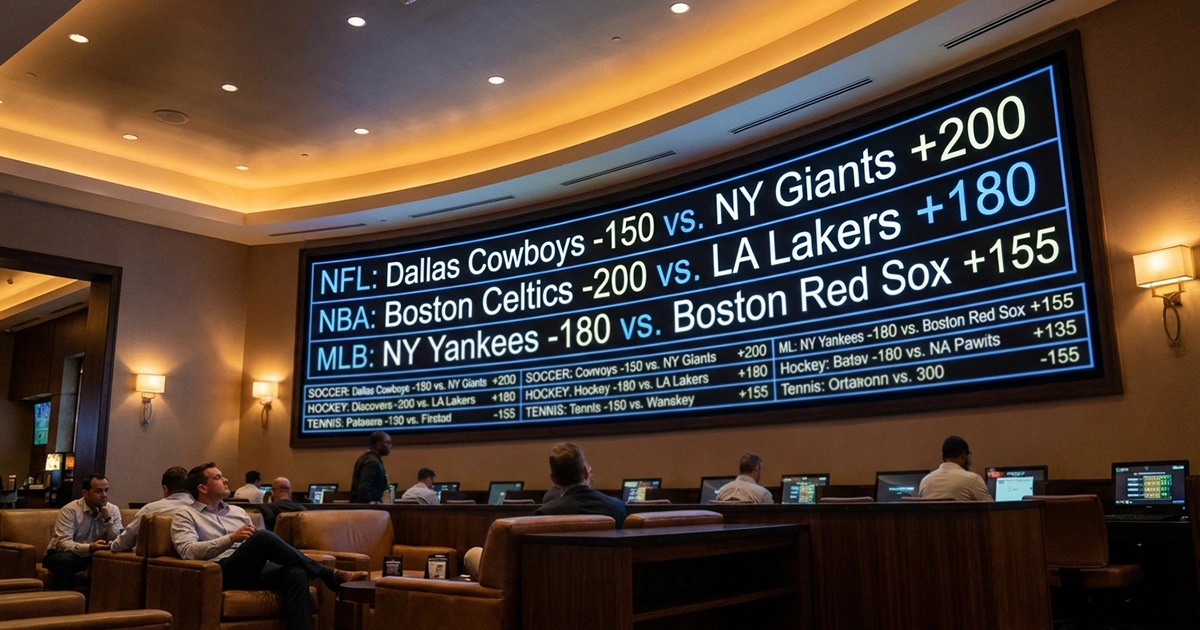
Moneyline betting strips sports wagering down to its purest form: pick the winner. No point spreads to calculate, no margins of victory to consider, no complicated conditions to satisfy. Your team either wins or it does not. This simplicity makes moneyline bets accessible to beginners while remaining strategically important for experienced bettors who understand when straight-up wagers offer better value than spread alternatives.
The apparent simplicity masks genuine strategic depth. Deciding between a favourite at -180 and an underdog at +160 involves probability assessment, bankroll consideration, and understanding when the moneyline offers superior value to the spread. Heavy favourites require you to risk substantial money for modest returns, while underdogs promise lucrative payouts that materialise less frequently. Neither approach is inherently correct – the right choice depends entirely on whether the odds accurately reflect true winning probability.
Moneyline betting dominates certain sports where point spreads feel artificial or where low-scoring games make margins unpredictable. Baseball and hockey are primarily moneyline sports because runs and goals are scarce enough that handicapping by 1.5 becomes the default spread for virtually every game. Football and basketball offer moneylines alongside spreads, creating opportunities to choose whichever bet type offers better value for a given matchup.
Table of Contents
How Moneyline Odds Work
American moneyline odds centre everything around the number 100. Positive odds indicate profit on a $100 stake; negative odds indicate the stake required to profit $100. A team listed at +200 returns $200 profit on a $100 bet if they win. A team at -200 requires a $200 bet to return $100 profit. The sign immediately identifies favourites (negative) and underdogs (positive).
The magnitude of the number reflects probability. A -300 favourite is considered significantly more likely to win than a -130 favourite. The bookmaker believes you need to risk three times your potential profit because the outcome is relatively certain. Conversely, a +300 underdog offers triple your stake in profit because winning is considered unlikely. Converting these odds to implied probability reveals the bookmaker’s actual assessment: -300 implies approximately 75% win probability, while +300 implies approximately 25%.
The gap between favourite and underdog prices reflects the bookmaker’s margin. In a perfectly fair market with a true 50/50 matchup, both sides would be priced at +100 (even money). In reality, you might see -110 on both sides, with the 10% premium on each representing the bookmaker’s edge. This margin varies by sport, league, and bookmaker – shopping for the best available price on your chosen side directly impacts long-term profitability.
Calculating potential returns from moneyline odds is straightforward once you understand the system. For positive odds, divide by 100 and multiply by your stake to find profit. For negative odds, divide 100 by the absolute value and multiply by your stake. A $50 bet at +150 returns $75 profit. A $50 bet at -150 returns approximately $33.33 profit. Adding your original stake to the profit gives total payout.
The Favourite Trap
Betting on favourites feels safe. They win more often than underdogs by definition – that is precisely why they are favoured. This psychological comfort draws recreational bettors toward favourites disproportionately, creating what professionals call the favourite trap. Winning frequently is not the same as winning profitably, and the mathematics often work against favourite bettors despite their higher win rate.
Consider a favourite at -200, implying approximately 67% win probability. If you bet $200 to win $100 repeatedly, you need to win more than two of every three bets just to break even. At exactly 67% win rate over 100 bets, you would win 67 times (collecting $6,700 in profit) and lose 33 times (losing $6,600 in stakes). Your net result is essentially breakeven before accounting for any house edge. If the true probability is actually 65% rather than 67%, you lose money despite winning most of your bets.
Heavy favourites at -300 or beyond create even more precarious mathematics. One upset wipes out the profit from multiple winning bets. If you bet $300 to win $100 three times and win all three, you profit $300. If you bet $300 to win $100 a fourth time and lose, you are back to zero – four bets, three wins, no profit. The psychological sting of watching hard-won gains evaporate from a single loss leads many bettors to chase or increase stakes, compounding the problem.
This is not to say favourites are always bad bets. When a favourite is underpriced – when the true probability exceeds the implied probability – betting them generates positive expected value. The key is recognising that “likely to win” does not automatically mean “profitable to bet.” You must assess whether the price is fair relative to actual winning chances, not simply whether the team is good.
The Underdog Opportunity

Underdogs win less often but pay more when they do. This asymmetry creates opportunity for bettors willing to accept lower win rates in exchange for larger individual payouts. The mathematics of underdog betting can be surprisingly forgiving – you do not need underdogs to win often for the strategy to profit.
An underdog at +200 needs to win only 33.3% of the time to break even. If you identify situations where an underdog’s true winning probability exceeds the implied probability, you generate long-term profit even while losing more bets than you win. Finding a +200 underdog with 40% true win probability is extraordinarily valuable, even though you will still lose 60% of those bets.
Public betting patterns often inflate underdog value. Casual bettors gravitate toward favourites, particularly popular teams with national followings. This one-sided action pushes favourite prices lower (requiring more risk for less reward) while pushing underdog prices higher (offering more reward for the same risk). Sharp bettors exploit this by systematically fading public favourites, especially in high-profile games where casual money dominates.
Home underdogs represent a historically profitable angle in several sports. The combination of home-field advantage and underdog status creates situations where true win probability often exceeds implied probability. Historical data shows NFL home underdogs of 3 points or fewer have won outright over 40% of the time – remarkable for teams receiving plus-money odds typically in the +130 to +150 range.
Sport-Specific Considerations
Baseball is the quintessential moneyline sport. The standard run line of -1.5 applies to nearly every game, making moneyline the primary market for most bettors. Starting pitching drives baseball moneylines dramatically – an ace facing a struggling starter can push prices to -200 or beyond, while two mid-rotation starters might produce a near pick-em. The high variance of baseball (even bad teams win 40% of games) means underdogs cash frequently enough to sustain aggressive underdog strategies.
First-five-innings moneylines offer a baseball-specific variant that isolates starting pitcher performance from bullpen variance. If you have strong conviction about a pitching matchup but worry about late-game volatility, F5 moneylines let you bet on that conviction without bullpen risk. These markets carry their own pricing and often differ from full-game moneylines based on bullpen assessments.
Hockey mirrors baseball in its reliance on moneylines over spreads. The standard puck line of -1.5 is difficult for favourites to cover given how frequently NHL games finish within one goal. Goaltending matchups drive pricing, and the prevalence of overtime and shootouts adds randomness that benefits underdogs. Low-scoring games mean any team can beat any other team on a given night, making hockey underdogs viable more frequently than in higher-scoring sports.
Football and basketball offer moneylines alongside point spreads, creating strategic choices. When the spread is small (1-3 points), moneyline underdogs become attractive because they offer plus-money for teams the market views as nearly even. When spreads are large (7+ points), favourite moneylines often require such heavy juice that spread bets become preferable. The relationship between spread and moneyline pricing reveals which bet type offers better value for specific matchups.
When Moneyline Beats the Spread
The moneyline versus spread decision depends on your confidence level and the specific numbers involved. Certain situations systematically favour one bet type over the other.
Small spread, high confidence in underdog: If a team is +3 and you genuinely believe they will win outright, the moneyline (perhaps +130 to +150) offers better value than the spread. You are getting paid plus-money for an outcome you expect. Taking +3 is fine if you think they might lose close, but if you expect a win, the moneyline maximises returns.
Large spread, moderate confidence in favourite: If a team is -10 and you like them to win but are uncertain about margin, the moneyline might appeal despite requiring heavy juice. Covering a 10-point spread is difficult; winning outright is easier. Whether the moneyline price justifies this depends on specific numbers – -400 is rarely worth it, but -250 might be depending on your probability estimate.
Close game expected: When you anticipate a tight contest, moneylines on either side can offer value because the point spread provides minimal cushion anyway. A +3 underdog in a game you expect to be decided by a field goal might as well be bet on the moneyline for the enhanced payout.
Parlay construction: Moneylines combine cleanly in parlays when you want to back multiple favourites without requiring each to cover spreads. A three-team favourite moneyline parlay might return +200 or better while requiring only three teams to win outright. The tradeoff is that one upset busts the entire parlay, making favourite parlays high-risk despite the seemingly “safe” individual selections.
Building a Moneyline Strategy

Successful moneyline betting requires honest probability assessment and price discipline. Before betting any moneyline, estimate the true win probability for each side. Compare your estimate to the implied probability from the odds. If your estimate exceeds implied probability, the bet has positive expected value; if not, pass.
Track favourite and underdog bets separately in your records. Many bettors discover they have edge in one category but not the other. Perhaps you excel at identifying vulnerable favourites (profiting on underdogs) but consistently overvalue underdogs when backing favourites. This granular tracking reveals where your actual edge lies.
Line shop relentlessly for moneylines. The difference between +145 and +155 on an underdog represents meaningful long-term value. Because moneylines carry more variance than spreads (you are betting on binary win/lose rather than margins), getting the best price matters more. A half-point on a spread might not decide many bets, but 10 cents on a moneyline directly affects every outcome.
Finally, consider moneylines as part of a broader strategy rather than in isolation. Sometimes the moneyline is the right bet; sometimes the spread offers better value; sometimes both are poor choices and you should pass entirely. Flexibility to choose the optimal bet type for each situation – or decline to bet when no good options exist – separates profitable bettors from those who force action regardless of value.