
How Betting Odds Work Complete Beginner’s Guide
 Available in US

Betting odds are the language of sports wagering. They tell you two essential things: how likely something is to happen, and how much money you stand to win if it does. Yet for many newcomers, staring at numbers like -150, 2.50, or 6/4 feels like deciphering ancient hieroglyphics. The good news is that once you understand the underlying logic, odds become remarkably intuitive. The bad news is that bookmakers count on you not understanding them.
Every betting market in the world operates on the same fundamental principle: odds represent probability expressed as a number. Whether you are looking at a Premier League match in London, an NFL game in Las Vegas, or a cricket test in Mumbai, the mathematics remain identical. Only the presentation changes. Bookmakers in different regions have developed their own conventions for displaying odds, which is why the same bet might appear as +200, 3.00, or 2/1 depending on where you are placing it. All three numbers mean exactly the same thing – your potential return is double your stake.
Understanding odds is not optional if you want to bet intelligently. Without this foundation, you cannot calculate potential payouts, compare prices between bookmakers, or identify when a bet offers genuine value. You are essentially gambling blind, which is precisely how recreational bettors lose money over the long term. This guide will demystify all three major odds formats and show you exactly how to use them.
Table of Contents
The Three Odds Formats Explained
Decimal odds are the simplest format to understand and the most widely used globally. Popular across Europe, Australia, and Canada, decimal odds show your total return for every unit staked, including your original bet. The number you see is simply a multiplier. If the odds are 2.50 and you bet $10, your total return is $25 (2.50 multiplied by $10). Your profit would be $15, since $10 of that return is your original stake coming back.
The beauty of decimal odds lies in their transparency. You never need to do mental gymnastics – larger numbers always mean bigger payouts and lower probability. Odds of 1.50 indicate a strong favourite, while odds of 10.00 suggest a significant underdog. Anything below 2.00 means the outcome is considered more likely than not to happen. Even money, where you double your stake on a winning bet, is expressed as 2.00. This clean mathematical relationship makes decimal odds particularly useful for comparing different bets and calculating accumulator payouts, where you simply multiply all the decimal odds together.
Converting decimal odds to implied probability requires just one simple calculation: divide 100 by the odds. For decimal odds of 4.00, the implied probability is 25% (100 divided by 4). For odds of 1.50, the implied probability is approximately 66.7% (100 divided by 1.50). This calculation becomes second nature with practice and allows you to quickly assess whether a bookmaker’s price reflects reality.
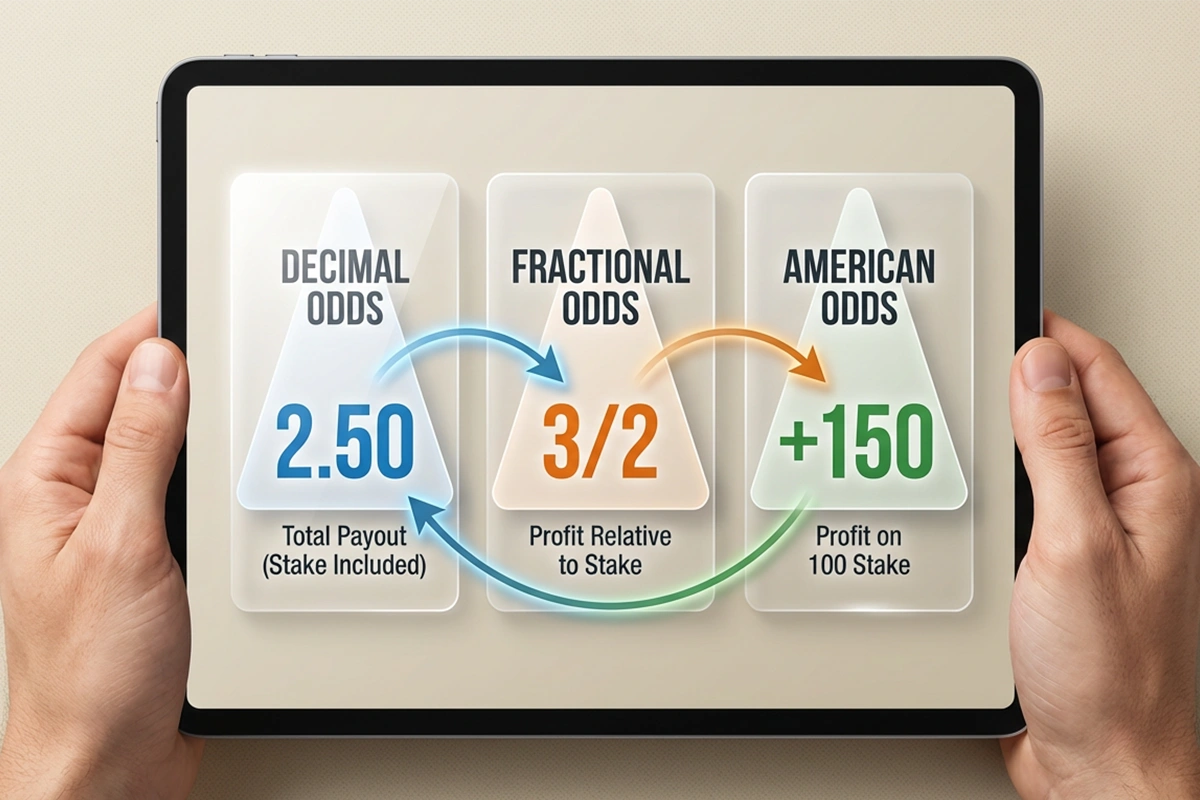
Fractional odds remain the traditional format in the United Kingdom and Ireland, particularly for horse racing. They express the profit you will receive relative to your stake. Odds of 5/1 (pronounced “five to one”) mean you will win five units of profit for every one unit staked. If you bet $10 at 5/1 and win, you receive $60 – your $50 profit plus your original $10 stake returned.
The numerator (top number) represents potential profit, while the denominator (bottom number) represents the stake required. When the numerator is larger than the denominator (like 3/1 or 7/2), the selection is considered an underdog. When the denominator is larger (like 1/3 or 2/5), the selection is an odds-on favourite – you must risk more than you stand to win. Odds of 1/1, called “evens,” mean your profit equals your stake.
Calculating implied probability from fractional odds requires adding the two numbers together and dividing the denominator by that sum. For 3/1 odds: 1 divided by (3+1) equals 0.25, or 25% probability. For 1/4 odds: 4 divided by (1+4) equals 0.80, or 80% probability. Fractional odds can feel cumbersome for complex calculations, which is why even British bookmakers increasingly offer decimal alternatives.
American odds, also called moneyline odds, dominate the United States market. They centre everything around the number 100 and use positive or negative signs to indicate underdogs and favourites respectively. Positive odds (like +200) show how much profit you would win from a $100 bet. Negative odds (like -150) show how much you must bet to win $100 profit.
The sign immediately tells you which side the bookmaker favours. A team at -200 is considered a heavy favourite – you would need to risk $200 to win $100 profit. A team at +200 is an underdog – a $100 bet would return $200 profit if successful. The standard “juice” or commission on evenly matched bets typically appears as -110 on both sides, meaning you must risk $110 to win $100 regardless of which outcome you choose.
Converting American odds to implied probability differs depending on the sign. For positive odds, divide 100 by (the odds plus 100). For +200: 100 divided by 300 equals 33.3%. For negative odds, divide the absolute value by (the absolute value plus 100). For -200: 200 divided by 300 equals 66.7%. The asymmetric nature of American odds takes some adjustment, but the format does make identifying favourites and underdogs instantaneous.
Converting Between Formats
Moving between odds formats is essential when comparing prices across international bookmakers. The conversion formulas are straightforward once you memorise them, though online calculators eliminate the need for mental arithmetic in practice.
To convert decimal to fractional: subtract 1 from the decimal odds. Decimal 3.50 becomes 2.50, expressed as 5/2. Decimal 2.00 becomes 1.00, expressed as 1/1 (evens). The resulting number is your fractional odds, though you may need to simplify the fraction for conventional presentation – 1.50 in decimal becomes 0.50, which is typically written as 1/2.
To convert decimal to American: if the decimal is 2.00 or higher, subtract 1 and multiply by 100 to get positive American odds. Decimal 3.00 becomes +200 (3 minus 1 equals 2, multiplied by 100). If the decimal is below 2.00, divide -100 by (decimal minus 1) to get negative American odds. Decimal 1.50 becomes -200 (negative 100 divided by 0.50).
To convert fractional to decimal: divide the fraction and add 1. Odds of 7/4 become 2.75 (7 divided by 4 equals 1.75, plus 1). Odds of 1/3 become 1.33 (1 divided by 3 equals 0.33, plus 1). This conversion is particularly useful when building accumulators, since multiplying decimal odds is far easier than working with fractions.
To convert American to decimal: for positive odds, divide by 100 and add 1. American +150 becomes 2.50 (150 divided by 100 equals 1.50, plus 1). For negative odds, divide 100 by the absolute value and add 1. American -200 becomes 1.50 (100 divided by 200 equals 0.50, plus 1).
The ability to fluidly convert between formats allows you to shop for the best prices regardless of how different bookmakers display their odds. A difference that appears marginal in one format often looks more significant in another, making conversions a practical skill rather than an academic exercise.
Why Odds Matter More Than You Think
Every percentage point of edge matters over the long term. The difference between odds of 2.10 and 2.20 might seem trivial on a single $10 bet – an extra dollar of potential profit. But across hundreds of bets, these small differences compound dramatically. Professional bettors obsess over getting the best available price because they understand that consistently taking 2.10 when 2.20 is available elsewhere essentially donates money to bookmakers.
Odds also reveal the bookmaker’s true opinion about an event. When you see a team priced at 1.50, the market is telling you this outcome has roughly a 67% chance of occurring. If your own analysis suggests the true probability is 75%, you have potentially found a value bet – the odds are better than they should be. Conversely, if you think the probability is only 55%, the bookmaker is overpricing this favourite, and you should look elsewhere.
The implied probability built into odds also exposes the bookmaker’s margin. In a hypothetical two-outcome event with 50/50 chances, fair odds would be 2.00 on each side. But you will rarely find this in practice. Instead, you might see 1.91 on both outcomes. Converting both to implied probability (52.4% each) and adding them together gives you 104.8% – that extra 4.8% is the bookmaker’s overround, their built-in profit margin regardless of the result.
Understanding this relationship between odds, probability, and margin is what separates informed bettors from casual punters. The numbers on a betting slip are not arbitrary – they encode genuine information about expected outcomes and bookmaker confidence. Learning to read this information fluently is the first step toward betting with your eyes open rather than simply hoping for the best.
Practical Application

Start by choosing one odds format and mastering it completely before worrying about conversions. For most bettors, decimal odds offer the clearest path to understanding since they require the least mental manipulation. Set your preferred bookmaker accounts to display decimal odds and practice calculating potential returns until the maths becomes automatic.
Next, develop the habit of checking implied probability for every bet you consider. Before placing a wager, convert the odds to a percentage and ask yourself honestly: do I believe this outcome is more likely than this number suggests? If you cannot articulate why your assessment differs from the market’s, you probably should not be making the bet.
Finally, maintain accounts with multiple bookmakers and compare odds before every wager. The same match might be priced at 2.10 with one bookmaker and 2.25 with another – taking the better price increases your potential return by over 7% without changing the risk at all. This practice, called line shopping, is perhaps the single easiest way to improve your betting results immediately.
Odds are the foundation upon which all betting decisions rest. Without understanding them, you cannot evaluate whether a bet offers value, calculate your expected returns, or compare opportunities across different markets and bookmakers. With understanding, you gain the tools to approach sports betting as an informed participant rather than a hopeful gambler.