
Futures Betting Long Term Wagers on Championships and Awards
 Available in US

Futures betting transforms sports wagering from a daily activity into a season-long investment. Rather than betting on tonight’s game, you are betting on who will win the championship next February, which player will claim MVP honours, or whether a team will exceed its projected win total over an entire season. Your money remains locked until the outcome is decided – weeks or months from when you place the wager – creating a different relationship with both risk and reward than standard game betting provides.
The appeal of futures is immediately apparent. A modest bet placed at the right time can return substantial profit. Taking a championship longshot at +2500 before the season means a $100 bet returns $2,500 if that team wins it all. The Kansas City Chiefs were available at +1200 during their 2020 Super Bowl winning season after starting 4-4 – bettors who bought low captured extraordinary value. These stories of prescient futures bets fuel the market’s popularity.
However, futures betting presents unique challenges that single-game wagering does not. Your capital is tied up for extended periods, earning nothing while it waits. The house edge on futures markets is significantly higher than on spreads or totals. Injuries, trades, and unpredictable season developments can destroy a futures ticket that looked brilliant when placed. Understanding both the opportunities and limitations of futures is essential before committing significant bankroll to these long-term positions.
Table of Contents
Types of Futures Markets
Championship futures represent the most popular and widely available markets. Every major sports league offers betting on the eventual champion: Super Bowl winner, NBA Finals winner, World Series champion, Stanley Cup winner, and equivalents across college sports and international competitions. These markets open almost immediately after the previous season ends and remain available throughout the following season, with odds adjusting continuously based on team performance.
Conference and division futures narrow the focus to intermediate goals. Betting on which team will win the AFC or NFC offers better probability than picking the Super Bowl winner, reflected in shorter odds. Division winner markets narrow further still. These intermediate futures can provide value when you are confident in a team’s regular-season prospects but uncertain about their playoff potential.
Season win totals operate as over/under bets on a team’s regular-season performance. Sportsbooks project how many games each team will win, and bettors decide whether the actual result will exceed or fall short of that projection. A team with an 11.5 win total line requires you to predict whether they will win 12 or more games (over) or 11 or fewer (under). Win totals combine elements of futures and traditional betting, settling after the regular season regardless of playoff outcomes.
Player award futures cover individual honours like MVP, Rookie of the Year, Defensive Player of the Year, and sport-specific awards like the Cy Young in baseball or the Norris Trophy in hockey. These markets depend on individual performance and voter perception, adding complexity beyond team outcomes. Statistical production, team success, and narrative all influence award voting.
Statistical leader futures bet on which player will lead a category over the full season: passing yards, home runs, scoring, assists. These differ from award futures because they are determined by objective statistics rather than voting, reducing uncertainty about how voters will behave while increasing dependence on playing time and opportunity.
The Mathematics of Futures
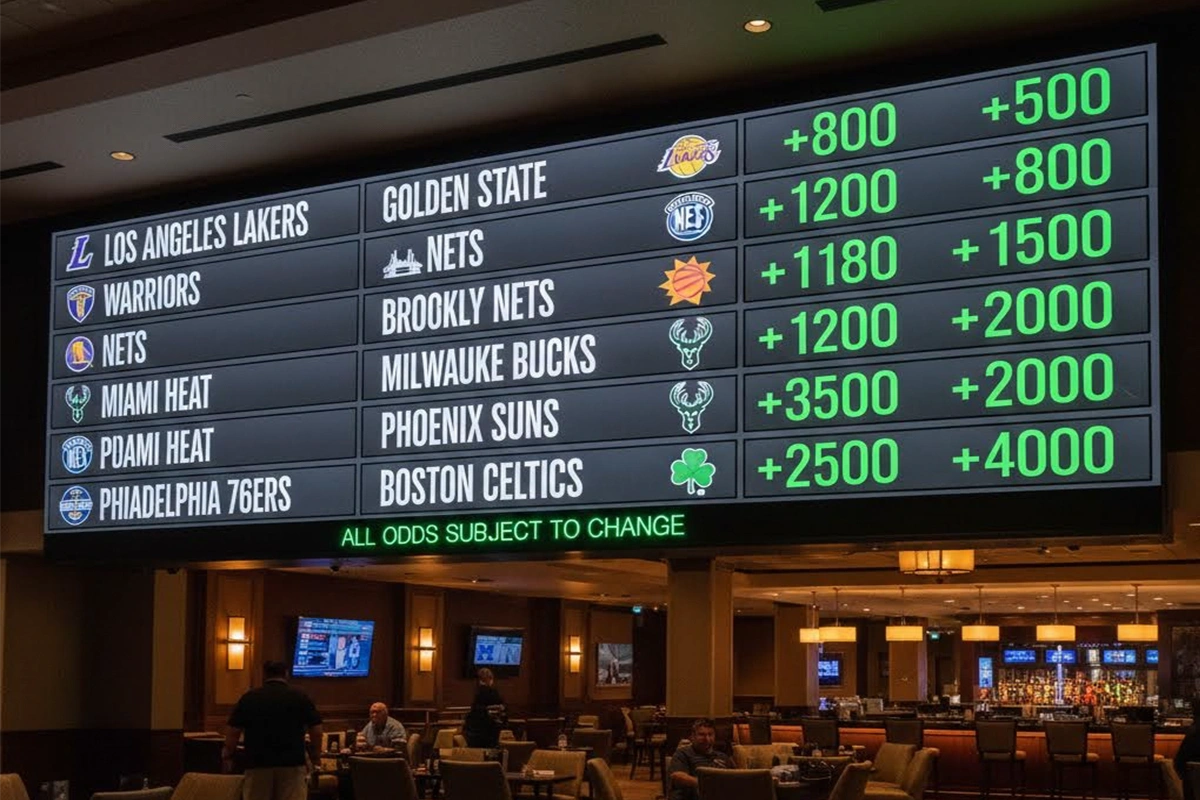
Futures markets carry substantially higher house edges than single-game betting. While a typical spread carries roughly 4.5% hold, championship futures often exceed 20% hold when all outcomes are summed. The sportsbook profits regardless of which team wins because the combined implied probabilities of all options significantly exceed 100%.
Consider an NFL futures market where the implied probabilities sum to 125%. That extra 25% represents the bookmaker’s theoretical edge across the entire market. Individual bettors face this disadvantage on every ticket, meaning you need substantial accuracy to overcome the built-in margin. The entertainment value of futures partially justifies this higher cost, but serious bettors must acknowledge the mathematical headwind.
Your odds are locked at the moment you place the bet. If you take a team at +1200 before the season and they become +300 favourites by playoff time, you still hold the +1200 ticket. This cuts both ways – your locked odds might prove valuable as the team improves, or worthless if the team collapses. The locked-odds structure creates opportunities for both savvy betting and painful losses.
The opportunity cost of tied-up capital matters for serious bettors. Money sitting on a futures ticket cannot be deployed on daily games where it might compound through repeated positive-expectation wagers. A sharp bettor who generates 5% ROI on single games might find that grinding out small edges provides better returns than hoping a futures ticket pays off months later.
Strategic Approaches
Season win totals attract the sharpest futures bettors because they reduce uncertainty compared to championship markets. You are not trying to predict whether a team will navigate a seven-game playoff gauntlet – only whether they will win more or fewer regular-season games than projected. Teams that are solid but not championship-calibre can still easily beat their win total line without needing playoff success.
Win total analysis focuses on roster changes, schedule strength, and injury history. A team that lost key players might be set at 8.5 wins when their actual talent suggests 7 wins – value on the under. A team returning a healthy star from injury might exceed conservative projections. Sharp bettors often find win totals more predictable than any other futures market because they depend on sustained performance rather than single-elimination playoff variance.
Buy low opportunities emerge when strong teams struggle early. A legitimate contender that starts slowly might see their championship odds balloon from +400 to +1200 during a losing streak. If the underlying talent remains intact and the slow start reflects bad luck or fixable problems, buying at inflated odds captures significant value. The Kansas City Chiefs example illustrates this perfectly – a talented team temporarily underperforming became available at enormous odds.
Hedging becomes relevant when your futures ticket gains value through the team’s success. If you hold a +2000 championship ticket and the team reaches the final, those odds have essentially compressed toward even money. You can bet the opponent to guarantee profit regardless of outcome, or let your original ticket ride for maximum potential return. The decision depends on your risk tolerance and bankroll situation.
Award futures require predicting not just performance but narrative. MVP voting considers team success alongside individual statistics, meaning the best statistical player on a mediocre team might lose to a less productive player whose team contends. Understanding what voters value – and how that might differ from raw performance – is essential for award market success.
Timing Considerations
When you place futures bets dramatically affects value. Preseason odds incorporate maximum uncertainty; once games are played, information is revealed and odds adjust. Neither timing is inherently better – each offers different opportunities.
Early-season betting captures value when you correctly anticipate outcomes that the market has not yet priced. If you believe a team is significantly underrated before the season, their preseason odds offer maximum value because the market has not yet observed their actual performance. However, early betting also maximises your exposure to unpredictable events like injuries.
Mid-season betting allows you to incorporate actual results into your analysis. You have seen how the team performs, who is healthy, how the coaching adjustments are working. This additional information reduces uncertainty but is already partially reflected in adjusted odds. The value comes from disagreeing with how the market has interpreted the observed performance.
Late-season betting offers the shortest time horizon but the most information. Teams are largely settled, injury situations are known, and playoff paths are clearer. However, odds are also shortest because contender fields have narrowed. Late betting works best when you identify specific factors the market undervalues despite full information availability.
Win totals specifically must be bet before the season begins or very early, as sportsbooks close these markets after a few weeks of games. If win totals represent your preferred futures approach, preseason research and prompt action are required.
Risk Management
Diversification across multiple tickets can reduce variance while maintaining upside exposure. Rather than betting $200 on a single championship ticket, you might spread $50 across four plausible contenders. If any hits, you profit; if none hit, your loss is capped. This approach sacrifices maximum potential return for reduced volatility.
Proportional betting allocates more to higher-probability outcomes and less to longshots. A bet on a +300 favourite risks more capital than a flier on a +5000 longshot because the favourite is more likely to return money. This mirrors sound bankroll management principles from single-game betting.
Avoiding emotional attachment is particularly important with futures. Betting your favourite team to win the championship feels satisfying regardless of whether the odds justify it. This emotional satisfaction often comes at the expense of expected value because sportsbooks shade popular teams’ odds knowing fans will bet regardless.
Limiting futures exposure as a percentage of total bankroll prevents excessive capital tie-up. If half your bankroll sits on futures tickets, you lack the flexibility to capitalise on daily opportunities. Many successful bettors limit futures to 5-10% of their total bankroll, preserving the majority for higher-turnover strategies.
Common Pitfalls

Betting too early on insufficient information destroys many futures tickets. Preseason hype creates overvalued teams whose odds reflect hope rather than realistic assessment. Waiting for actual games provides information that prevents betting on teams whose preseason buzz exceeded their actual quality.
Ignoring the house edge leads bettors to treat futures as equivalent to single-game betting. The significantly higher margins on futures mean fewer bets will be positive expected value. Selectivity matters more in futures than in spreads or totals.
Chasing longshots exclusively reflects misunderstanding of probability. Yes, hitting a +5000 ticket provides a life-changing payday. But +5000 implies roughly 2% probability, meaning you will lose this bet 98 times out of 100. The entertainment value of longshot tickets is real, but treating them as serious investments is a mistake.
Failing to hedge appropriately can turn winning positions into losses. If your futures ticket gains substantial value through team success, locking in guaranteed profit through hedging is often the rational choice. Greed – wanting to maximise the original ticket’s potential – can result in walking away with nothing when a hedge would have secured significant winnings.
Futures betting offers unique excitement and the potential for substantial returns on modest investments. The extended time horizon creates a different betting experience than daily wagering provides. However, the higher house edge, capital tie-up, and increased uncertainty require adjusted expectations. Approach futures as entertainment with profit potential rather than as a primary betting strategy.