
Betting Exchanges Peer to Peer Wagering
 Available in US
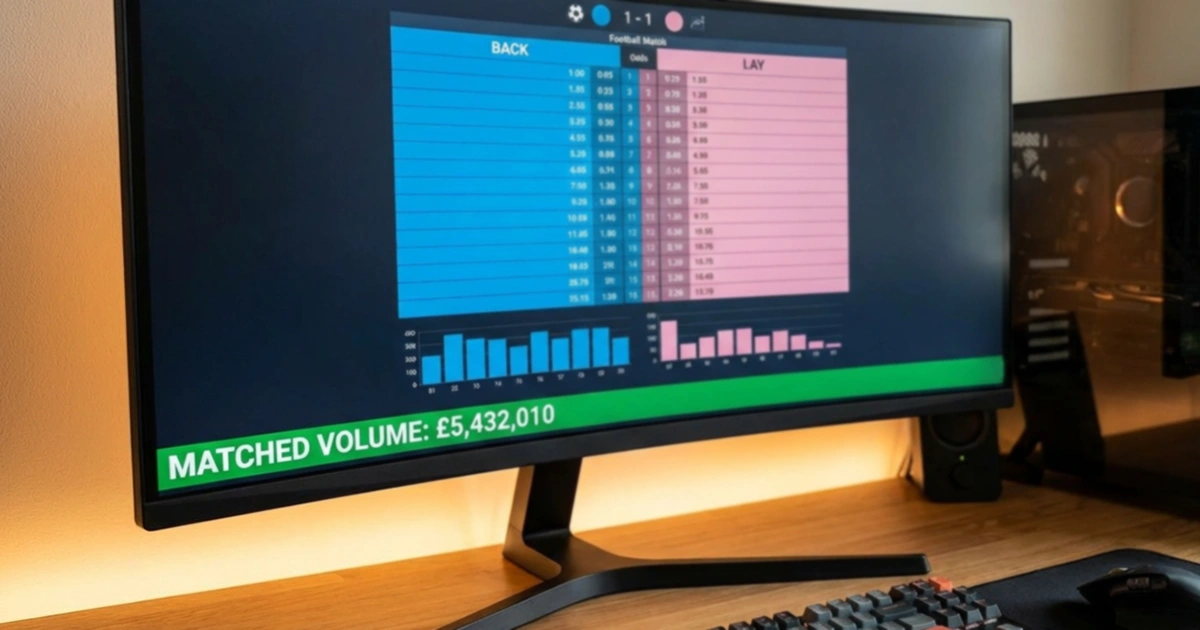
Betting exchanges represent a fundamentally different model from traditional sportsbooks. Rather than betting against a bookmaker who sets odds and takes the opposite side of every wager, exchange users bet against each other. The exchange simply provides the platform, matches opposing bets, and takes a small commission from winners.
This peer-to-peer structure creates several advantages: typically better odds (no built-in bookmaker margin), the ability to both back and lay outcomes, opportunities for trading and hedging, and freedom from account restrictions that plague winning bettors at traditional sportsbooks. The trade-offs include complexity, liquidity requirements, and limited availability in some jurisdictions.
Understanding how exchanges work opens strategic possibilities unavailable through conventional betting – particularly for sophisticated bettors comfortable with concepts like laying, liability management, and in-play trading.
Table of Contents
How Exchanges Work
On a traditional sportsbook, the bookmaker sets odds and accepts bets on all outcomes, building a margin into the prices that guarantees profit over time regardless of which outcome wins. You bet against the house.
On an exchange, other bettors take the opposite side of your wager. If you want to back Team A to win, another user must be willing to lay Team A (bet that Team A will not win). The exchange matches these opposing positions and facilitates settlement.
The exchange earns revenue through commission on winning bets, typically 2-5% of net profits depending on the platform and your betting volume. This commission replaces the traditional bookmaker margin and is generally much lower – meaning better effective odds for bettors.
Betfair Exchange, launched in 2000, pioneered this model and remains the largest exchange globally. Other notable exchanges include Smarkets and Matchbook, with Prophet Exchange operating in select US states.
Backing and Laying
The ability to lay – bet against an outcome – is the defining feature that distinguishes exchanges from sportsbooks.
Backing works identically to traditional betting. You stake money on an outcome you want to happen. If it happens, you win at the stated odds; if not, you lose your stake.
Laying means betting that something will not happen. When you lay a selection, you are essentially playing the role of bookmaker for that bet. If the selection loses (your lay bet wins), you win the backer’s stake minus commission. If the selection wins (your lay bet loses), you must pay out at the odds you offered.
Consider a football match where you lay the home team at odds of 3.0 (2/1) for £10. If the home team loses or draws, you win the £10 stake. If the home team wins, you pay out £20 (the backer wins £10 at 2/1 odds, meaning £20 profit on their £10 stake). Your potential loss (£20) is your liability – money held by the exchange to ensure you can pay if the lay loses.
This creates flexibility unavailable at traditional sportsbooks. In a three-way football market, if you think the home team will not win but are unsure whether the away team will win or the match will draw, you can simply lay the home team rather than trying to pick between the other two outcomes.
The Odds Advantage
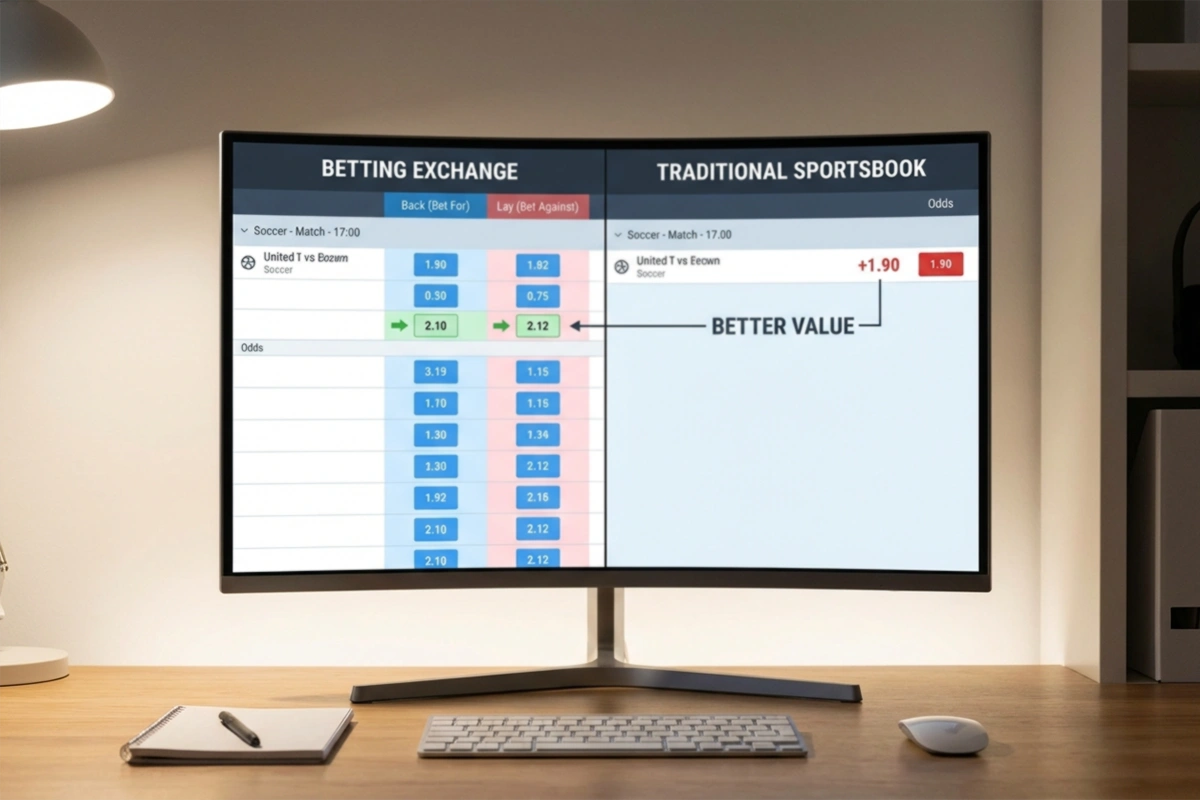
Exchange odds are typically better than sportsbook odds because there is no bookmaker margin built into prices. On a sportsbook, odds are set so the implied probabilities exceed 100% – the overround that guarantees bookmaker profit. On an exchange, odds are set by market participants competing against each other.
For a coin flip that should be priced at 2.0 (even money) on both sides, a sportsbook might offer 1.91 on each outcome – building in roughly 4.5% margin. An exchange for the same event might show 1.98 available to back and 2.02 available to lay, with the difference representing the spread between willing backers and layers rather than house edge.
Over thousands of bets, this difference compounds significantly. A bettor consistently getting 1.98 instead of 1.91 will show substantially better returns even with identical selection quality.
The catch is that exchange odds are only as good as market liquidity allows. On major events with millions matched, odds closely approximate true probability. On obscure events with thin liquidity, spreads widen and the odds advantage diminishes or disappears.
Understanding Liquidity
Liquidity refers to the amount of money available in a market at various prices. High liquidity means large bets can be matched quickly at competitive prices. Low liquidity means you may not find anyone willing to take the other side of your bet, or may have to accept worse odds to get matched.
The exchange display shows available money at different price points. You might see £5,000 available to back at 2.0, £3,000 at 2.02, and £8,000 at 2.04. If you want to back £1,000, you can get matched immediately at 2.0. If you want to back £10,000, you would need to accept progressively worse prices for portions of your bet.
Liquidity concentrates around popular events. Premier League football matches, major horse racing, and high-profile tennis tournaments attract millions in matched volume. Lower-league football, minor racing, and less popular sports may have minimal liquidity – sometimes making it impossible to get meaningful bets matched.
This liquidity constraint is the primary practical limitation of exchange betting. The theoretical odds advantage exists only where sufficient liquidity allows you to actually get matched.
Trading and Hedging
Because you can both back and lay, exchanges enable trading – taking positions at one price and closing them at another to lock in profit regardless of outcome.
Suppose you back a horse at 10.0 (9/1) before a race. News breaks that the favourite has been withdrawn, and your horse’s price drops to 6.0 (5/1). You can now lay the horse at 6.0, creating a position where you profit regardless of whether it wins.
If you backed £10 at 10.0, you would win £90 profit if it wins. If you now lay £15 at 6.0, you have £75 liability if it wins but collect £15 if it loses. The net position: if the horse wins, you receive £90 from your back bet but pay £75 on your lay bet (£15 profit). If it loses, you lose your £10 stake but win £15 from your lay (£5 profit). You have locked in profit regardless of outcome – this is called greening up.
This trading capability enables strategies impossible on traditional sportsbooks: scalping small price movements for consistent small profits, backing early and hedging when odds move, or adjusting positions as in-play events unfold.
Commission Structures
Exchanges charge commission on net winnings rather than building margin into odds. Understanding how commission works is essential for calculating true expected returns.
Betfair’s standard commission is 5% of net market winnings, though frequent users can qualify for reduced rates. Smarkets charges 2% as standard. Matchbook uses 0% commission on certain markets with higher rates elsewhere.
Commission is calculated on net winnings per market, not per bet. If you back and lay in the same market, only your net profit (if any) is subject to commission. This makes trading more viable than it would be if commission applied to every winning bet individually.
When comparing exchange odds to sportsbook odds, factor in commission. If the exchange offers 2.10 to back with 5% commission, your effective odds are 2.10 × 0.95 = 1.995 in terms of actual payout. This is usually still better than sportsbook alternatives, but the gap narrows at higher commission rates.
Advantages for Serious Bettors
Exchanges offer particular benefits for bettors who would be limited at traditional sportsbooks:
No account restrictions based on winning. Sportsbooks limit or close accounts of consistently profitable bettors because those bettors cost the house money. Exchanges are indifferent to who wins – they take commission regardless – so winning does not trigger restrictions.
Better odds on most markets, particularly close to event start times when exchange liquidity peaks and the market has efficiently processed available information.
Laying capability opens strategies like laying heavy favourites in fields where value exists elsewhere, or laying specific outcomes you have strong conviction against.
Trading opportunities allow locking in profits before events conclude, managing risk dynamically, and profiting from price movements regardless of final outcome.
Transparency in seeing exactly what prices others are willing to offer rather than accepting bookmaker-determined odds.
Limitations and Considerations
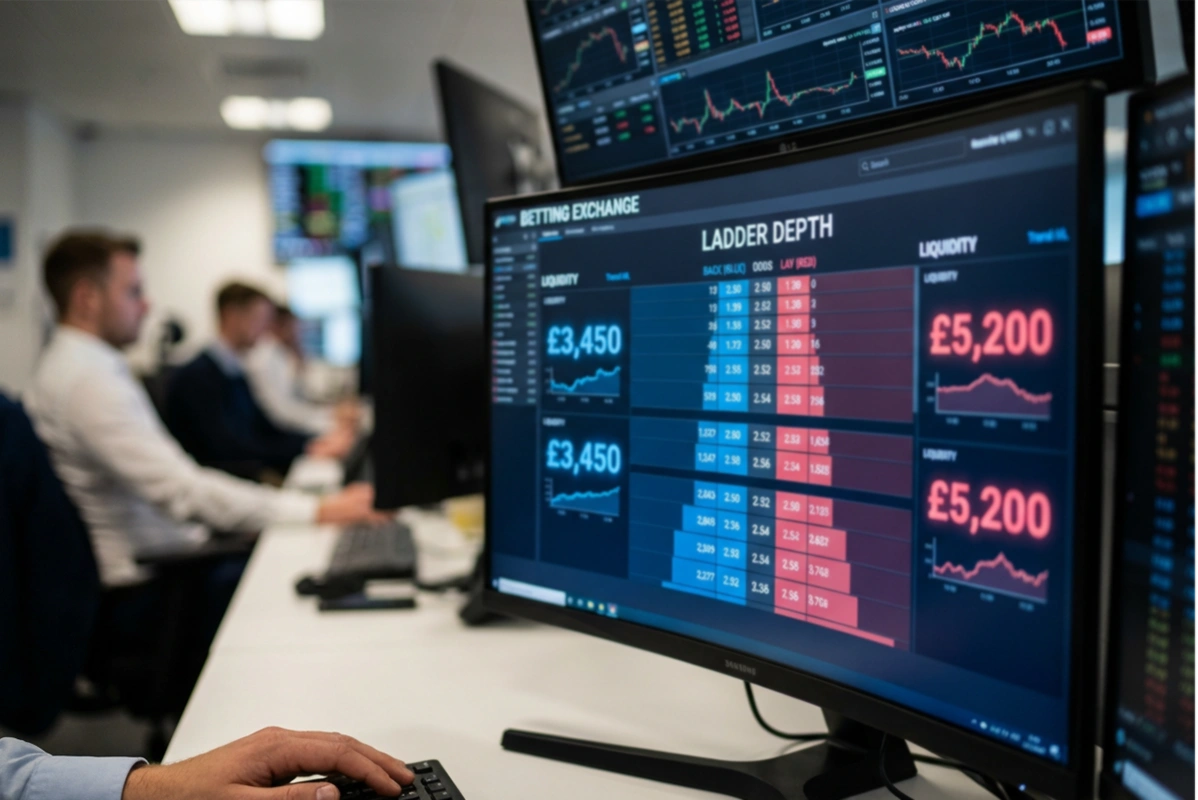
Liquidity constraints limit betting capacity on smaller events. If only £500 is available in a market, you cannot bet £5,000 no matter how good the opportunity looks.
Complexity requires understanding backing, laying, liability, matching, and commission – more concepts than simply picking a team and staking money.
Geographic availability varies significantly. Betfair operates primarily in the UK, Europe, and Australia; US exchange availability is very limited and state-dependent.
Unmatched bets can occur when no one takes the other side at your requested price. You may need to adjust your odds to get matched, potentially giving up value.
Liability management for laying requires careful attention. A £10 lay bet at odds of 10.0 creates £90 liability – significantly more than your potential win. Poor liability awareness can overextend your bankroll.
Using Exchanges Strategically
For bettors with access to both exchanges and traditional sportsbooks, the optimal approach often involves using both:
Compare prices between exchanges and sportsbooks for every bet. Sometimes the sportsbook offers promotional odds or temporarily superior prices; usually the exchange is better for markets with adequate liquidity.
Use exchanges for markets where you have strong convictions in either direction – back what you like, lay what you oppose.
Employ trading strategies when pre-event information creates price movements you can anticipate and exploit.
Maintain exchange accounts for their account-limiting immunity even if you primarily bet elsewhere. The option to bet without restriction has value even if rarely exercised.
Reserve sportsbook betting for markets with poor exchange liquidity, promotional offers, and accumulator-style bets that exchanges typically do not support well.
Exchanges fundamentally shift the betting landscape from you-versus-bookmaker to you-versus-market. For sophisticated bettors comfortable with this model, the advantages – better odds, trading capability, freedom from limits – can significantly improve long-term results.