
Parlay and Accumulator Bets High Risk High Reward
 Available in US
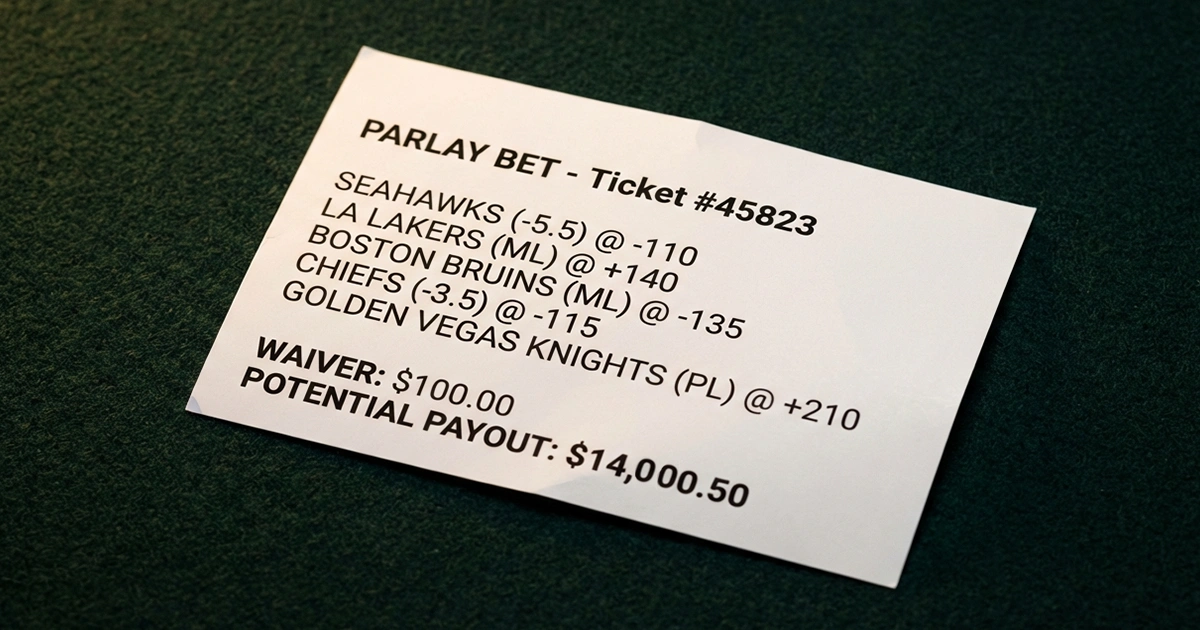
Parlay betting – known as accumulator betting or simply “acca” in British markets – represents the most tantalising proposition in sports wagering. By combining multiple selections into a single bet, you multiply the odds together, creating potential payouts that dwarf anything achievable with individual wagers. A modest stake can theoretically return life-changing sums if every leg hits. This mathematical amplification explains why parlays dominate recreational betting despite being demonstrably inferior to single bets from an expected value perspective.
The allure is understandable. Watching your five-team parlay survive the first four legs, waiting anxiously on the final game with thousands of dollars hanging in the balance – this delivers an adrenaline experience that single bets simply cannot match. The dream of turning $20 into $2,000 captivates the imagination in ways that grinding out small profits through disciplined single-bet strategies never will. Sportsbooks understand this psychology intimately, which is why they aggressively promote parlay betting and make it effortlessly easy through mobile app interfaces.
Yet the mathematics are unforgiving. Every selection you add to a parlay decreases your probability of winning while the bookmaker’s margin compounds multiplicatively. The house edge that might be 4.5% on a single bet balloons to over 30% on a six-team parlay. Professional bettors almost universally avoid parlays for this reason – they sacrifice too much expected value chasing unlikely large payouts. Understanding both the appeal and the danger of accumulator betting helps you make informed decisions about when (if ever) parlays belong in your betting approach.
Table of Contents
How Parlays Work
A parlay combines two or more individual wagers into a single bet where all selections must win for the bet to pay out. If any selection loses, the entire parlay loses regardless of how the other legs performed. This all-or-nothing structure creates the high-variance, high-reward profile that defines parlay betting.
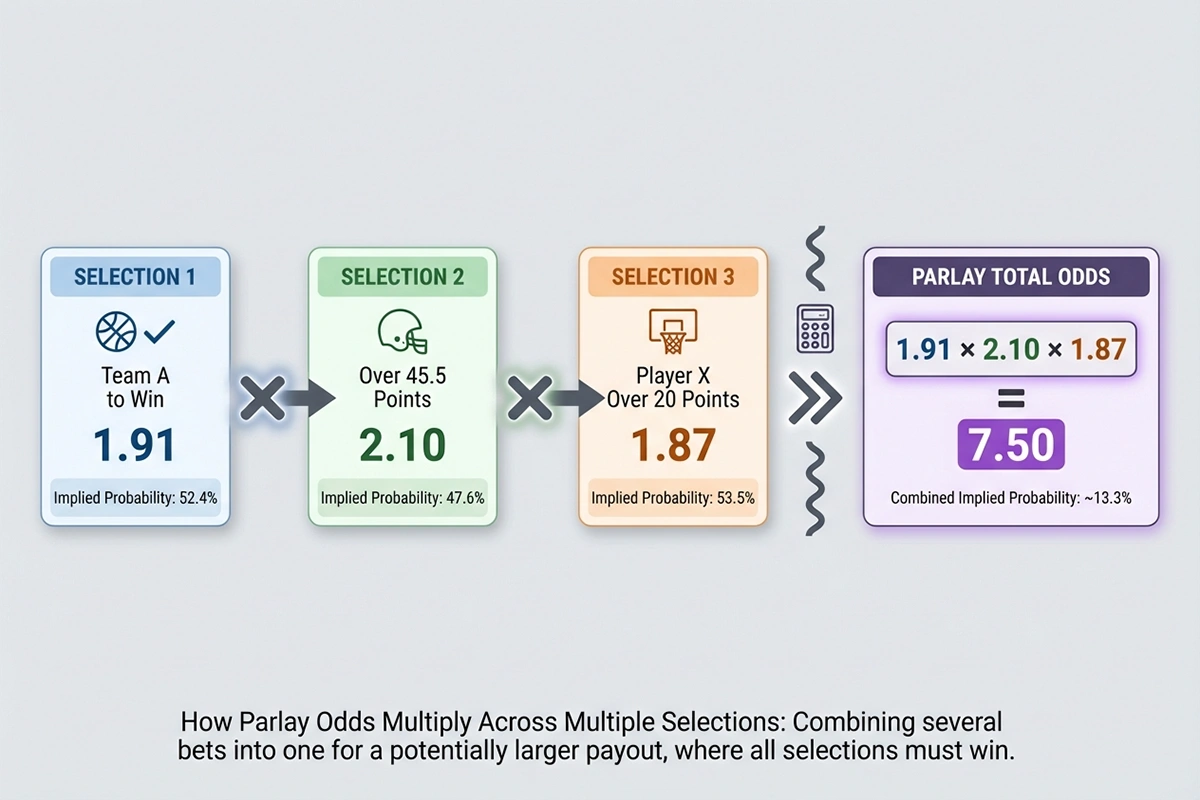
The odds calculation is straightforward: multiply the decimal odds of each selection together to get the parlay’s total odds, then multiply by your stake for potential return. A three-team parlay with selections at 1.91, 2.10, and 1.87 decimal odds produces combined odds of 7.50 (1.91 x 2.10 x 1.87 = 7.50). A $10 stake returns $75 if all three legs win.
In American odds format, you must convert each selection to decimal, multiply, then convert back if desired. Most bettors find decimal odds simpler for parlay calculations, which is why experienced parlay bettors often switch their display preferences regardless of geographic location.
Pushes (ties) and voided legs typically reduce the parlay rather than killing it entirely. If one leg of a four-team parlay pushes, the bet becomes a three-team parlay with recalculated odds. House rules vary slightly between sportsbooks, so verify specific policies before betting. Some books treat pushes less favourably, particularly on promotional parlays or same-game combinations.
The terminology varies by region. Americans say “parlay” while British and European markets use “accumulator” or “acca.” Specific parlay sizes have names: a two-team parlay is a “double,” three teams is a “treble,” four teams is a “four-fold,” and so on. These terms are interchangeable in meaning – all describe multi-selection bets where every leg must win.
The Mathematics Against You
Parlays are mathematically inferior to equivalent single bets, and the disadvantage grows with each leg added. This is not opinion but mathematical fact that every serious bettor should understand before placing accumulator wagers.
Consider the house edge on a standard -110 spread bet: approximately 4.5%. If you bet two such spreads as singles and both win, you keep both profits minus the vig on each. If you parlay them, the sportsbook pays you at 2.64-to-1 rather than the true odds of 3-to-1 (assuming 50% win probability on each). That gap between true odds and paid odds represents the compounded house edge – now roughly 10% instead of 4.5%.
A three-team parlay at standard -110 odds pays approximately 6-to-1, but true odds are 7-to-1. A four-team parlay pays around 12.28-to-1 versus true odds of 15-to-1. The gap widens with each additional selection because the bookmaker’s margin multiplies at every step.
The practical impact is severe. A bettor who consistently hits 55% of spread bets – a genuinely skilled handicapper – generates positive expected value on singles. That same bettor loses money on parlays because the compounded house edge overwhelms their skill advantage. The edge that produces profit on individual bets gets eaten by the exponentially growing margin on accumulators.
This mathematical reality explains why sportsbooks love parlay bettors and promote the bet type so aggressively. A 2025 industry report noted that while parlays represent a minority of total bets by volume, they generate disproportionate profits for operators because the house edge is so much larger than on straight wagers.
Why People Bet Parlays Anyway
Despite the unfavourable mathematics, rational reasons exist for occasional parlay betting – though they rarely justify the frequency with which recreational bettors use accumulators.
Entertainment value is legitimate. If your betting bankroll is primarily for entertainment rather than profit-seeking, parlays deliver more excitement per dollar wagered. A $20 parlay on a Sunday NFL slate creates sustained engagement across multiple games, with each result affecting your bet’s fate. That experiential value has worth, even if the expected monetary return is negative.
Bankroll limitations sometimes make parlays practical. A bettor with $50 in their account who wants action on five games could bet $10 singles on each, or could parlay all five. The parlay offers a chance at a significant payout that $10 singles cannot provide. For small-bankroll recreational bettors, this lottery-ticket approach provides access to meaningful wins that their limited funds otherwise preclude.
Correlated outcomes occasionally create genuine parlay value. If two events are positively correlated – meaning one outcome increases the likelihood of the other – parlaying them can capture value that independent single bets miss. A team’s defence being excellent correlates with under bets on the same game. Same-game parlays can exploit these relationships, though sportsbooks increasingly adjust odds to account for obvious correlations.
Promotional opportunities sometimes tilt parlay mathematics favourably. Boosted odds, parlay insurance (refunding stakes if one leg loses), and bonus bet requirements can create positive expected value situations that would not exist otherwise. Sophisticated bettors exploit these promotions strategically while avoiding unenhanced parlays.
Parlay Strategy If You Must
If you choose to bet parlays despite their mathematical disadvantages, certain approaches minimise the damage and maximise entertainment value.
Keep legs limited. The house edge compounds with each selection, so shorter parlays sacrifice less expected value. Two-team and three-team parlays give up far less edge than five-team or six-team combinations. The enormous potential payouts of large parlays come at an enormous mathematical cost.
Avoid extreme longshots. Including heavy underdogs (+300 or longer) in parlays amplifies variance without improving expected value. One upset can bust your entire parlay, and the odds on longshots already include substantial bookmaker margin. Building parlays from moderate prices (roughly -200 to +200) produces more sustainable results.
Seek correlated legs. Look for selections where one outcome genuinely increases the probability of another. A fast-paced basketball team winning correlates with the game going over the total. A dominant defensive team winning correlates with under. Same-game parlays built around coherent game narratives can offer better value than random combinations.
Shop parlay odds. Different sportsbooks offer different parlay payouts for identical selections. Some books use fixed parlay cards with set multipliers while others calculate true odds on each combination. The variation between books can be substantial – always check multiple options before locking in your accumulator.
Use promotions wisely. Parlay insurance, boosted legs, and profit boosts occasionally create positive expected value situations. When they do, bet them. When they do not, recognise that you are paying for entertainment rather than investing wisely. The promotional calendar often dictates when parlay betting makes any mathematical sense.
Set strict limits. Allocate a small, fixed portion of your bankroll for parlay entertainment and accept that this money is likely lost. Never chase parlay losses with larger parlays, and never use parlay betting as your primary wagering strategy. Treat accumulators as a recreational supplement to disciplined single-bet handicapping.
Hedging Parlays
As your parlay survives early legs, you face decisions about whether to hedge – placing bets on opposing outcomes to guarantee some profit regardless of the final leg’s result. Hedging reduces your maximum potential payout but eliminates the risk of losing everything after being so close to winning.
Consider a five-team parlay where four legs have won and the fifth game is about to begin. Your parlay currently has value – if it hits, you collect a large payout. By betting the opposite outcome of your parlay’s final leg, you can lock in guaranteed profit. The bet on the opposing side wins if your parlay busts; your parlay pays if the final leg hits. Either way, you profit.
The mathematics of hedging depend on your parlay’s remaining odds, the live betting lines available, and your risk tolerance. Perfect hedging aims to equalise profit regardless of outcome. Partial hedging accepts reduced guaranteed profit in exchange for higher upside if the parlay completes.
Many bettors refuse to hedge on principle, feeling it “jinxes” the parlay or undermines the point of betting accumulators for large payouts. This is psychologically understandable but mathematically irrational. If your parlay has reached a point where hedging creates guaranteed profit, the hedge is objectively valuable. Whether you exercise that option depends on your goals and risk preferences, but the option exists and should be considered.
Professional bettors who exploit promotional parlays often hedge aggressively, viewing the parlay as a vehicle for capturing promotional value rather than as a genuine wagering strategy. They bet the parlay to unlock the promotion, then hedge to lock in whatever profit the promotional terms allow.
Alternative Parlay Types

Beyond standard parlays, several variations exist that modify the all-or-nothing structure.
Teasers allow you to buy points on spread bets in exchange for reduced payouts. A standard six-point teaser moves each NFL spread by six points in your favour – a -7 favourite becomes -1, a +3 underdog becomes +9. All legs must still win, but the adjusted spreads improve your chances. Teasers crossing key numbers (moving through 3 and 7 in football) offer the best value.
Pleasers work oppositely – you give points to the sportsbook in exchange for enhanced payouts. These are higher-risk, higher-reward variations that sophisticated bettors occasionally use when they expect comfortable margins of victory.
Round robins break your selections into multiple smaller parlays, ensuring that hitting some legs produces some return even if you miss others. A round robin on four selections might create six two-team parlays from the combinations. Hitting three of four legs produces winning parlays even though a standard four-team accumulator would lose.
System bets (popular in European markets) similarly allow partial success. A “2/3 system” on three selections pays if any two hit, with payouts calculated from those successful two-team combinations. These reduce variance compared to straight accumulators but also reduce maximum payouts.
Same-game parlays combine multiple selections from a single event. These have exploded in popularity through mobile app promotion, allowing bets like “Team A to win AND Player X over 25 points AND under 220.5 total.” Sportsbooks adjust odds for correlation, though the extent and fairness of these adjustments varies. Same-game parlays typically carry higher margins than traditional cross-game accumulators.
The Honest Assessment
Parlay betting is entertainment, not investment. The mathematics ensure that consistent parlay betting loses money faster than equivalent single-bet volume. Professional bettors avoid parlays almost entirely, using them only when promotional structures create rare positive-value opportunities.
If you enjoy parlays and accept them as entertainment expense, nothing is inherently wrong with occasional accumulator betting. Set aside a small portion of your bankroll, accept that you will likely lose it, and enjoy the excitement of chasing unlikely large payouts. Just understand what you are doing and why the sportsbooks are so eager for you to do it.
If your goal is profit rather than entertainment, parlays should comprise a tiny fraction of your betting activity – if any at all. Build your handicapping skills on single bets where your edge compounds in your favour rather than the bookmaker’s favour. Save the parlays for special occasions when promotional value justifies the mathematical sacrifice, or for small-stakes entertainment that does not affect your serious bankroll.
The dream of parlays – turning modest stakes into massive payouts – is real enough that it happens occasionally. The reality – that chasing this dream consistently loses money – is equally real and far more common. Understanding both truths positions you to make informed choices about whether and how accumulator betting fits your overall wagering approach.