
Decimal vs Fractional vs American Odds Which Format to Use
 Available in US
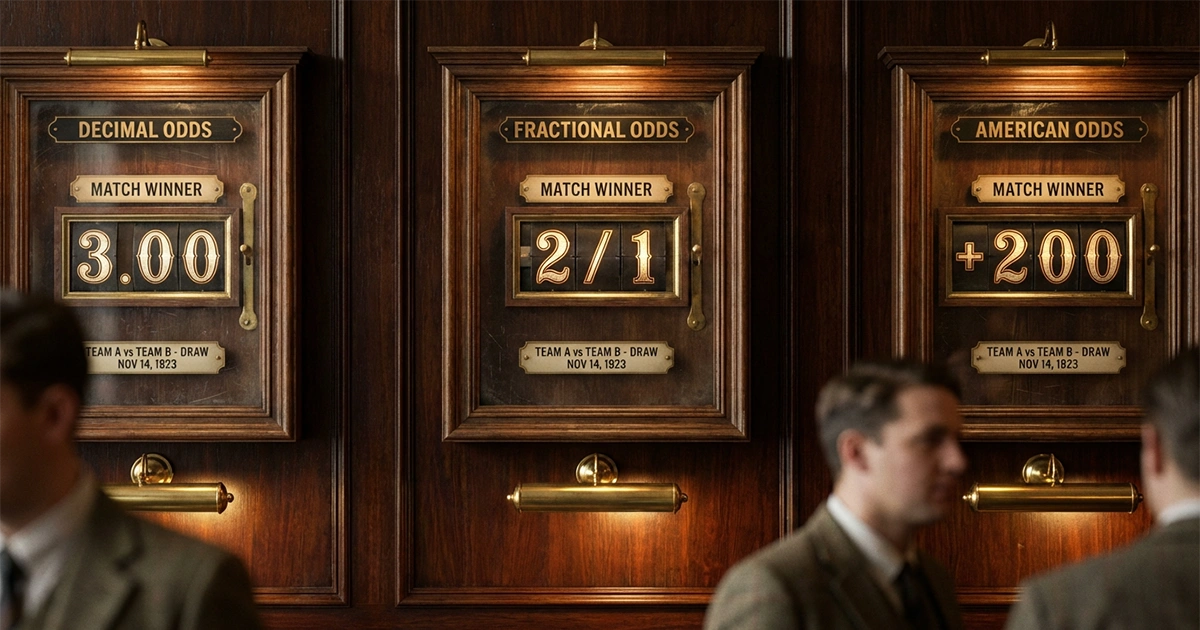
The same bet can look radically different depending on where you place it. A European sportsbook shows 3.00, a British bookmaker displays 2/1, and an American platform lists +200. All three numbers mean exactly the same thing – your potential return is triple your stake – but the presentation could not be more different. This fragmentation exists for purely historical reasons. Different betting cultures developed their own conventions, and those conventions persist even as online gambling has globalised the market.
For the modern bettor, odds format is primarily a matter of personal preference and familiarity. None of the three major systems is inherently superior; they all encode identical information about payouts and implied probability. However, each format has practical strengths and weaknesses that make it better suited to certain contexts. Understanding all three gives you flexibility to compare odds across international bookmakers, use the best available tools, and communicate effectively with other bettors regardless of their background.
The format you grew up with inevitably feels most intuitive, but developing fluency in alternatives pays dividends. British bettors who dismiss decimal odds as “continental nonsense” miss opportunities when European bookmakers offer better prices. American bettors who cannot parse fractional odds struggle to take advantage of UK racing markets. Serious bettors become multilingual out of necessity, switching formats as easily as switching between tabs in their browser.
Table of Contents
Decimal Odds: The International Standard
Decimal odds have conquered most of the world outside the United Kingdom and United States. They dominate in continental Europe, Australia, Canada, and increasingly in Asia. The format’s popularity is no accident – it represents the clearest and most mathematically convenient way to express betting odds.
The number displayed is simply a multiplier that includes your original stake. Odds of 2.50 mean that for every unit wagered, you receive 2.50 units back if successful, comprising 1 unit (your returned stake) plus 1.50 units (your profit). The calculation for potential return could not be simpler: stake multiplied by odds equals total payout. A $20 bet at 4.00 returns $80. No additional arithmetic required.
This simplicity extends to comparing values. Higher decimal odds always mean bigger potential payouts and lower implied probability. There is no ambiguity about which price is better – 2.15 beats 2.10 every time. You never need to mentally convert or calculate to compare two prices. Similarly, identifying favourites and underdogs is instantaneous: anything below 2.00 is odds-on (more likely than not to win), and anything above is odds-against.
Calculating implied probability from decimal odds requires dividing 100 by the odds. Decimal 4.00 implies a 25% chance (100 divided by 4). Decimal 1.50 implies a 66.7% chance (100 divided by 1.50). This quick conversion allows bettors to immediately assess whether the bookmaker’s view aligns with their own analysis. The cognitive load is minimal once the formula becomes automatic.
Perhaps the greatest advantage of decimal odds emerges when calculating accumulator returns. For a parlay, you simply multiply all the decimal odds together, then multiply by your stake. A three-leg accumulator at 1.80, 2.20, and 1.65 has combined odds of 6.534 (1.80 times 2.20 times 1.65). A $10 bet returns $65.34. Try doing that with fractional odds and you will quickly understand why betting exchanges and serious punters universally prefer decimals.
The main drawback is cultural unfamiliarity for those raised on other formats. British punters sometimes find decimal odds sterile and less evocative than traditional fractional prices. The richness of expressions like “six to four on” or “eight to one against” is lost when everything becomes a number with two decimal places. This is an aesthetic objection rather than a practical one, but aesthetics matter to many bettors.
Fractional Odds: The Traditional British Format

Fractional odds remain the default in United Kingdom and Irish betting, particularly for horse racing. They have a long and romantic history stretching back centuries, embedded in betting culture to a degree that decimal odds may never replicate. For many British punters, odds expressed as “9/2” or “7/4” simply feel right in a way that “5.50” or “2.75” do not.
The format expresses profit relative to stake. Odds of 5/1 (pronounced “five to one”) mean you win five units profit for every one unit staked. Odds of 1/4 (pronounced “four to one on” or “one to four”) mean you win one unit profit for every four units staked. The first number is always the profit; the second number is always the required stake to earn that profit. Your total return is the profit plus your stake returned.
When the first number exceeds the second (like 3/1, 7/2, or 10/1), the selection is an underdog with odds-against. When the second number exceeds the first (like 1/3, 2/5, or 4/9), the selection is a favourite with odds-on. When both numbers are equal (1/1, known as “evens”), you double your money on a winning bet. This structure conveys essential information at a glance without requiring calculation.
The nomenclature of fractional odds adds colour that other formats lack. “Nine to two,” “eleven to four,” “thirteen to eight” – these phrases carry weight in betting culture, immediately communicating value to experienced punters. Horse racing tipsters speak in fractions because the alternative would feel like translating poetry into spreadsheet data. Tradition has value, and fractional odds carry centuries of betting wisdom in their linguistic DNA.
However, fractional odds become cumbersome for certain calculations. Determining potential returns on unusual fractions like 13/8 or 85/40 requires actual arithmetic rather than intuition. Comparing 11/8 against 6/4 is not immediately obvious (they are equivalent to 2.375 and 2.50 respectively). Calculating accumulator returns using fractions is an exercise in frustration that even committed traditionalists typically abandon in favour of decimal conversion.
Converting fractional to decimal odds requires dividing the first number by the second, then adding one. So 5/1 becomes 6.00 (5 divided by 1, plus 1). And 1/4 becomes 1.25 (1 divided by 4, plus 1). The formula is simple enough, but having to perform it repeatedly adds friction to the betting process. Most British bookmakers now offer decimal odds as an alternative display option, and many experienced punters quietly switch formats for analytical work while appreciating fractional presentation for cultural reasons.
American Odds: The Moneyline System
American odds operate on an entirely different logic centred around the number 100. Positive odds indicate how much profit a $100 bet would generate. Negative odds indicate how much you must bet to generate $100 profit. The system seems bizarre to outsiders but becomes intuitive after sufficient exposure – just as fractional odds seem bizarre to Americans.
Positive odds like +200 mean a $100 bet returns $300 total ($200 profit plus $100 stake). The higher the positive number, the bigger the underdog and the larger the potential payout. +500 pays more than +200, which pays more than +150. This relationship mirrors decimal odds: bigger numbers mean bigger returns.
Negative odds like -150 mean you must risk $150 to win $100 profit. The more negative the number, the heavier the favourite. A team at -300 is considered more likely to win than a team at -150. This inverse relationship can confuse newcomers but aligns with common sense: betting on near-certainties should not pay very much, so you have to risk more to win less.
The standard “vig” in American betting manifests as -110 on both sides of point spreads and totals. This means you risk $110 to win $100 regardless of which side you choose. The $10 difference represents the bookmaker’s margin. When you see -110/-110, you immediately know this is a standard-margin market. Deviations from this baseline (like -105/-105 or -115/-105) signal either reduced or shifted margin.
American odds excel at instantly communicating the favourite/underdog dynamic. The plus and minus signs provide immediate visual identification without any calculation. You can scan a betting board and immediately identify which teams the market favours without parsing numbers. This clarity makes American odds popular for casual bettors who want quick information rather than precise probability.
The calculation for potential returns varies by sign. For positive odds, divide by 100 and multiply by your stake to get profit. For negative odds, divide 100 by the absolute value and multiply by your stake. A $50 bet at +180 returns $90 profit (180/100 = 1.8, times 50). A $50 bet at -180 returns $27.78 profit (100/180 = 0.556, times 50). These calculations are more complex than decimal multiplication, which is why serious American bettors often convert to decimals for analysis.
Choosing Your Primary Format
The right format depends on your betting context, goals, and geographic base. No single answer applies universally, though certain recommendations are well-supported.
For analytical work and calculation, decimal odds are unambiguously superior. Expected value calculations, probability assessments, accumulator pricing, and margin analysis all become simpler with decimals. Professional bettors and betting models almost universally standardise on decimal format regardless of the operator’s native display. If you build spreadsheets to track your betting or run any kind of systematic analysis, switch to decimals and never look back.
For American sports betting, American odds make sense as your primary display because that is what the market uses. Understanding moneyline conventions, standard -110 pricing, and line movement is easier when you are fluent in the native format. You can always convert to decimals for analysis while maintaining American literacy for market reading.
For UK horse racing and traditional betting culture, fractional odds retain genuine value. The vocabulary of racing – prices like “nine to four” or “five to two favourite” – assumes fractional fluency. Racing tipsters communicate in fractions. Track commentary uses fractions. Participating fully in British racing culture means accepting fractional odds as the lingua franca, even if you convert them privately for your own calculations.
For international betting and arbitrage, fluency in all three formats becomes essential. Arbitrage opportunities often arise between bookmakers using different conventions. Being able to quickly parse any odds format prevents mistakes and speeds execution. The small edge in arbitrage betting demands efficiency, and fumbling with conversions costs money.
Most online sportsbooks allow you to choose your preferred display format, so you need not abandon familiarity. However, developing at least reading fluency in all three systems opens opportunities and prevents confusion. You will encounter all formats at some point if you bet seriously, and struggling to understand a price costs you both time and potentially money.
Conversion Reference
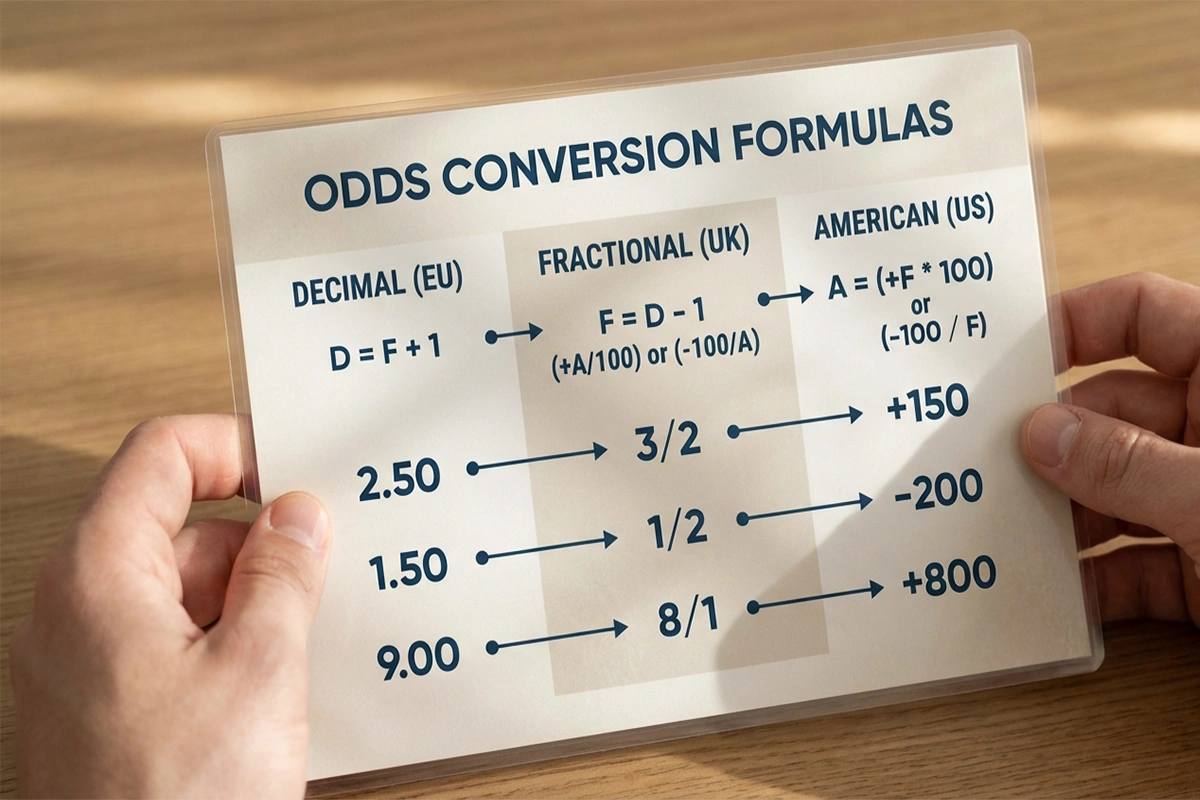
The formulas for converting between formats are worth memorising or keeping accessible:
Decimal to Fractional: Subtract 1, express as fraction. Decimal 2.50 becomes 1.50, expressed as 3/2 or 6/4.
Decimal to American: If decimal is 2.00 or higher, subtract 1 and multiply by 100 for positive American. Decimal 3.00 becomes +200. If decimal is below 2.00, divide -100 by (decimal minus 1). Decimal 1.50 becomes -200.
Fractional to Decimal: Divide numerator by denominator, add 1. Fractional 5/2 becomes 3.50.
Fractional to American: If fraction is greater than 1, multiply by 100 for positive American. Fractional 3/1 becomes +300. If fraction is less than 1, divide -100 by the fraction. Fractional 1/3 becomes -300.
American to Decimal: For positive, divide by 100 and add 1. American +150 becomes 2.50. For negative, divide 100 by the absolute value and add 1. American -150 becomes 1.67.
American to Fractional: For positive, divide by 100. American +200 becomes 2/1. For negative, create fraction with 100 as numerator and absolute value as denominator. American -200 becomes 100/200, simplified to 1/2.
Online calculators and odds converters eliminate the need for manual computation in practice. Bookmark a reliable converter and use it liberally until the translations become second nature. The goal is not to perform mental arithmetic but to develop intuition for how values relate across formats.
Odds format is ultimately a communication convention rather than a fundamental feature of betting markets. The underlying mathematics of probability, expected value, and margin remain identical regardless of presentation. Master the concepts first, then choose whatever display format makes those concepts easiest to work with in your particular context.